AI is changing enterprise software. But disruption does not automatically mean replacement.
One of Gartner's projections is that established vendors will remain dominant over the next three to five years, even as AI-native startups challenge them. This is a possible path, not a settled outcome.
The question is not simply who has the best AI. It is whether an alternative can deliver enough business value to justify the cost and risk of change.
A better experience is not enough
Enterprise platforms hold financial records, customer information, and operational data. They support permissions, compliance, and critical business processes.
Replacing them means more than introducing a new tool. It can require redesigning workflows, retraining employees, and accepting operational risk.
AI-native alternatives therefore need to earn their place. They must demonstrate better outcomes, lower total costs, or capabilities that existing software cannot provide. An impressive demonstration is not the same as a viable business case.
From predictable workflows to agentic experiences
Traditional software generally follows predefined rules. Users expect consistent results from the same process.
Agentic systems introduce a different experience. Users delegate objectives, and AI determines how to complete the work across applications.
Enterprises will need time to establish whether those outcomes are at least as satisfactory as their existing software. Accuracy, reliability, auditability, and accountability all matter.
The justification must cover more than potential productivity. It must explain where autonomy is appropriate, where approval remains necessary, and whether the benefits outweigh errors, oversight, and rework.
The interface changes. The dependence may not.
An AI assistant might check an invoice, update a customer record, and prepare a report without the employee opening SAP or Salesforce.
Yet those platforms may still supply the records, permissions, and business rules.
This headless model can make enterprise applications less visible without making them less important. It may also introduce new costs through additional API calls and transactions.
A simpler experience does not automatically mean greater freedom — or a lower bill.
Where AI economists can help
AI economists can help organizations test the business case during experimentation, before committing to scale.
They can establish the existing workflow's cost and performance, then compare the AI alternative against that baseline. The calculation should include integration, model usage, human review, errors, and ongoing support — not just token costs.
A break-even estimate asks: how much successful work must the AI solution deliver for its benefits to cover its total cost?
That gives experiments a decision threshold. Adoption becomes justified by demonstrated value, not enthusiasm alone.
References
- Gartner, presentation slides on the future of enterprise applications, 2026, supplied by the author; particularly slide 15, "Likely Scenario Till 2030: Incumbent Vendors Will Match Pace."
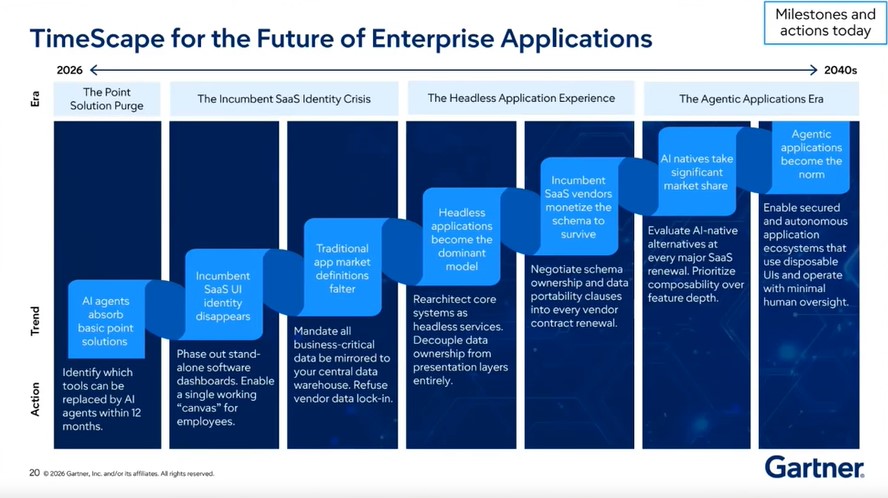
- Gartner, "TimeScape for the Future of Enterprise Applications," slide 20, 2026.