Cloud spend is complex, variable, untraceable, and difficult to analyze at scale due to its decentralized nature. FinOps practices help organizations regain control over cloud resources and expenses without slowing delivery or innovation.
This condensed methodology describes how to turn FinOps from a concept into an operating model. It is designed for large, complex organizations that require financial control, transparency, and accountability across cloud and technology spend.
FinOps is an operating model—an evolving, collaborative cloud financial management discipline and cultural practice—that enables engineering, finance, and business teams to make data-driven spending decisions and maximize business value.
Trade-offs and the FinOps Iron Triangle
Cloud mastery extends beyond technology. It is a challenge encompassing people, processes, systems, and organizational culture.
FinOps is a cultural operating model that balances cost, speed, and quality to maximize business value.
FinOps drives decisions through the Iron Triangle, balancing three critical dimensions:
| Dimension | Description |
|---|---|
| Speed | Time to market and delivery velocity |
| Quality | Performance, reliability, and availability |
| Cost | Financial efficiency and sustainability |
The objective of FinOps is not cost minimization, but optimization—making intentional trade-offs aligned with business outcomes.
1. FinOps Principles
| Principle | Context |
|---|---|
| Teams need to collaborate | Shared accountability replaces siloed decisions and improves outcomes |
| Business value drives technology decisions | Costs are evaluated using unit economics and value-based metrics |
| Everyone owns their cloud usage | Accountability is pushed to the edge and cost becomes an engineering concern |
| Cost data must be timely and accurate | Fast feedback prevents waste from compounding |
| FinOps should be enabled centrally | Governance is standardized while execution remains decentralized |
| Leverage the variable cost model of the cloud | Forecasting and just-in-time capacity replace static budgeting |
2. FinOps Framework
The FinOps Framework provides a single, unified view of the core principles, scope, strategies, capabilities, and personas that enable effective cloud financial management. It defines how personas interact, make trade-offs, and share accountability at cloud speed.
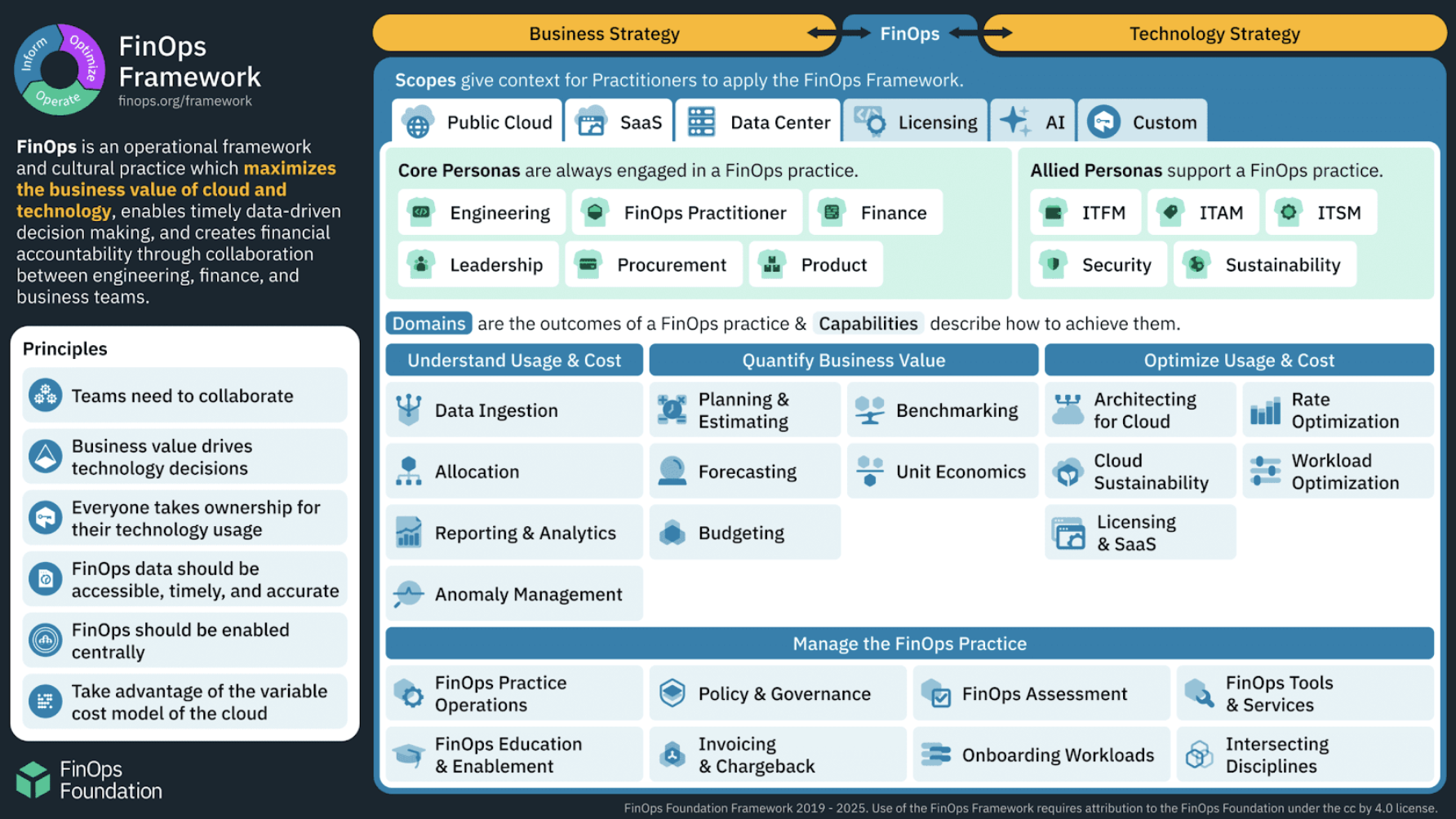
3. FinOps Maturity Model
FinOps maturity follows an iterative Crawl → Walk → Run progression. Capabilities mature through repeated execution, not one-time implementation.
| Level | Characteristics |
|---|---|
| Crawl | Basic visibility, limited ownership, early metrics |
| Walk | Standardized processes, allocation models, forecasting |
| Run | Predictive decision-making, automation, embedded accountability |
Maturity reflects behavioral adoption and decision quality—not tooling sophistication.
4. FinOps Operating Phases
FinOps operates as a continuous lifecycle:
| Phase | Behavioral Outcome |
|---|---|
| Inform | Visibility replaces assumptions |
| Optimize | Trade-offs become intentional |
| Operate | Cost accountability becomes routine |
6-Month 4-Phase (6M4P) FinOps Model
The 6M4P model aligns with the Inform → Optimize → Operate lifecycle while enabling early value realization and sustainable maturity.
| Phase | Focus | Duration |
|---|---|---|
| Phase 1 | Current state assessment | 8 weeks |
| Phase 2 | Rate optimization & financial control | 4 weeks |
| Phase 3 | Allocation and forecasting | 8 weeks |
| Phase 4 | Operational FinOps | 8 weeks |
5. FinOps Domains
FinOps domains describe the business outcomes achieved through FinOps practices.
| Domain | Purpose |
|---|---|
| Understand Usage & Cost | Establish visibility into usage, cost, and ownership |
| Quantify Business Value | Connect cost to outcomes through forecasting and unit economics |
| Optimize Usage & Cost | Drive efficiency through rightsizing and rate optimization |
| Manage the FinOps Practice | Sustain FinOps through governance, tooling, and enablement |
6. 6M4P Model – Implementation Plan Overview
| Phase | Key Deliverables |
|---|---|
| Phase 1 | Governance model, current-state assessment, risk register |
| Phase 2 | Rate optimization baseline, commitment strategy |
| Phase 3 | Allocation models, showback, forecasting |
| Phase 4 | Workload optimization, automation, savings realization |
7. Success Metrics per Phase
| Phase | Success Metrics |
|---|---|
| Phase 1 | ≥80% spend visibility and ownership clarity |
| Phase 2 | ≥70% commitment utilization and reduced effective rates |
| Phase 3 | ≥70% accurate allocation and ±15% forecast variance |
| Phase 4 | Validated savings and measurable maturity improvement |
8. Risk Mitigation Considerations
| Risk | Mitigation Strategy |
|---|---|
| Organizational change | Executive sponsorship and phased adoption |
| Data quality | Authoritative sources and incremental improvement |
| Adoption resistance | Central enablement and embedded governance |
Key Insight
FinOps fails not because technology is missing, but because behaviors do not change. When ownership is unclear, teams remain siloed, and leadership does not enforce accountability, cost data is ignored and optimization does not occur.
FinOps succeeds when roles, behaviors, and decision-making are aligned. Without that alignment, FinOps becomes reporting—not results.