The Science article "Sequential diagnosis with language models" examines two connected questions: how accurately can AI diagnose disease, and what does the diagnostic process cost?
Getting the right answer matters. So does the path taken to reach it.
Does the system ask a useful question first? Order unnecessary scans? Stop before gathering enough evidence?
Microsoft researchers evaluated these decisions together — measuring diagnostic accuracy alongside the estimated cost of the investigations requested.
How the simulation worked
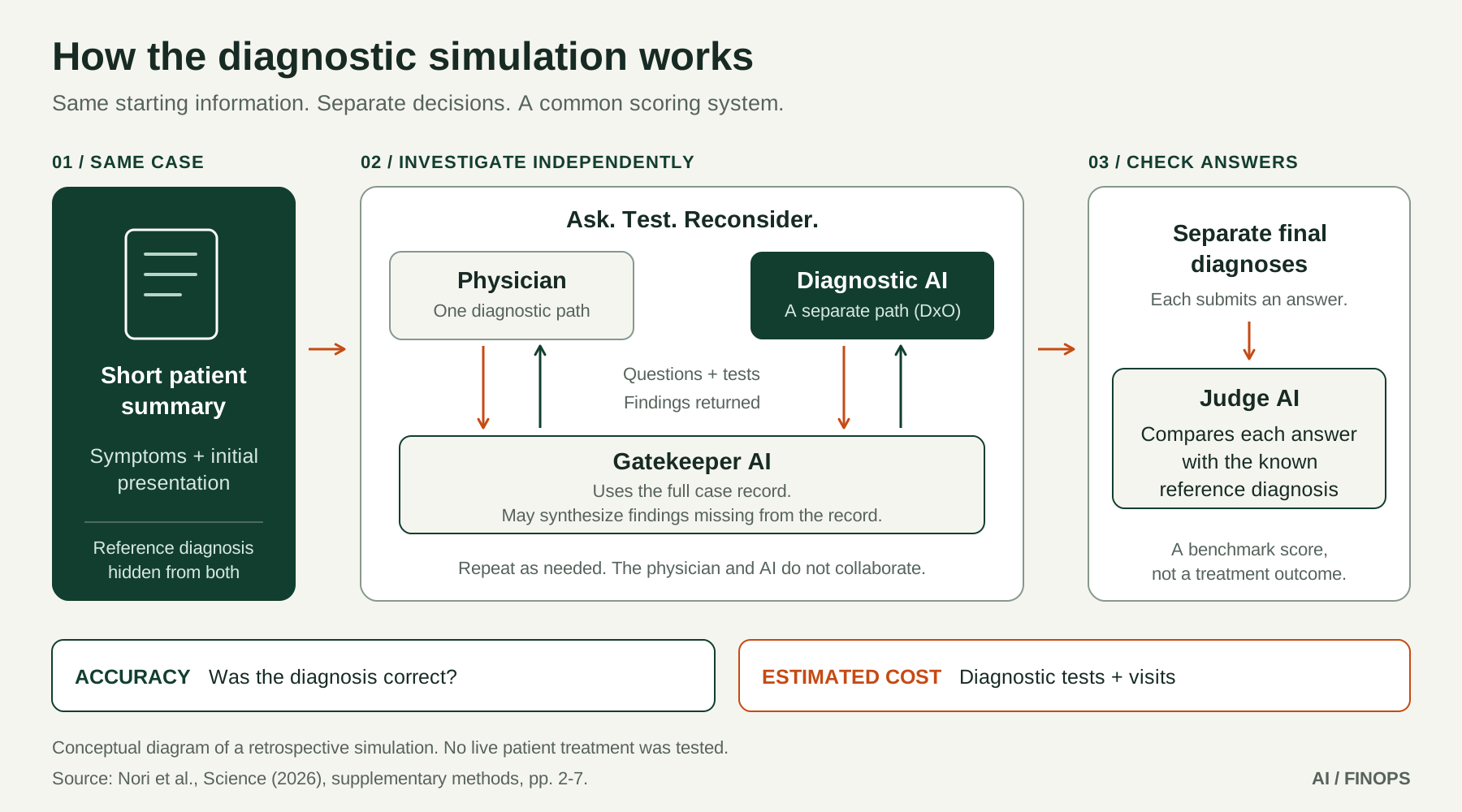
The researchers developed SDBench, a computer-based diagnostic simulation. They evaluated AI systems on 629 cases: 304 complex cases published in the New England Journal of Medicine and 325 cases drawn from hospital admissions originating in emergency departments.
These were retrospective cases with known reference diagnoses, not new patients receiving care.
Physicians and the diagnostic AI worked separately. Each began with the same short patient summary. They could ask questions, request examination findings, and order tests through another AI system called the Gatekeeper.
The Gatekeeper had access to the complete case record. It returned requested information without directly revealing the diagnosis. When information was missing, it could generate a plausible synthetic finding consistent with the case.
That is an important limitation: the simulation was not simply replaying recorded clinical facts.
Once a participant submitted a diagnosis, a Judge AI compared it with the reference diagnosis using a physician-authored scoring rubric.
Accuracy improved. Cost depended on the case.
Across the full datasets, the diagnostic orchestrator, DxO, achieved 83.2% accuracy on the complex cases and 80.3% on the emergency-department-origin cases.
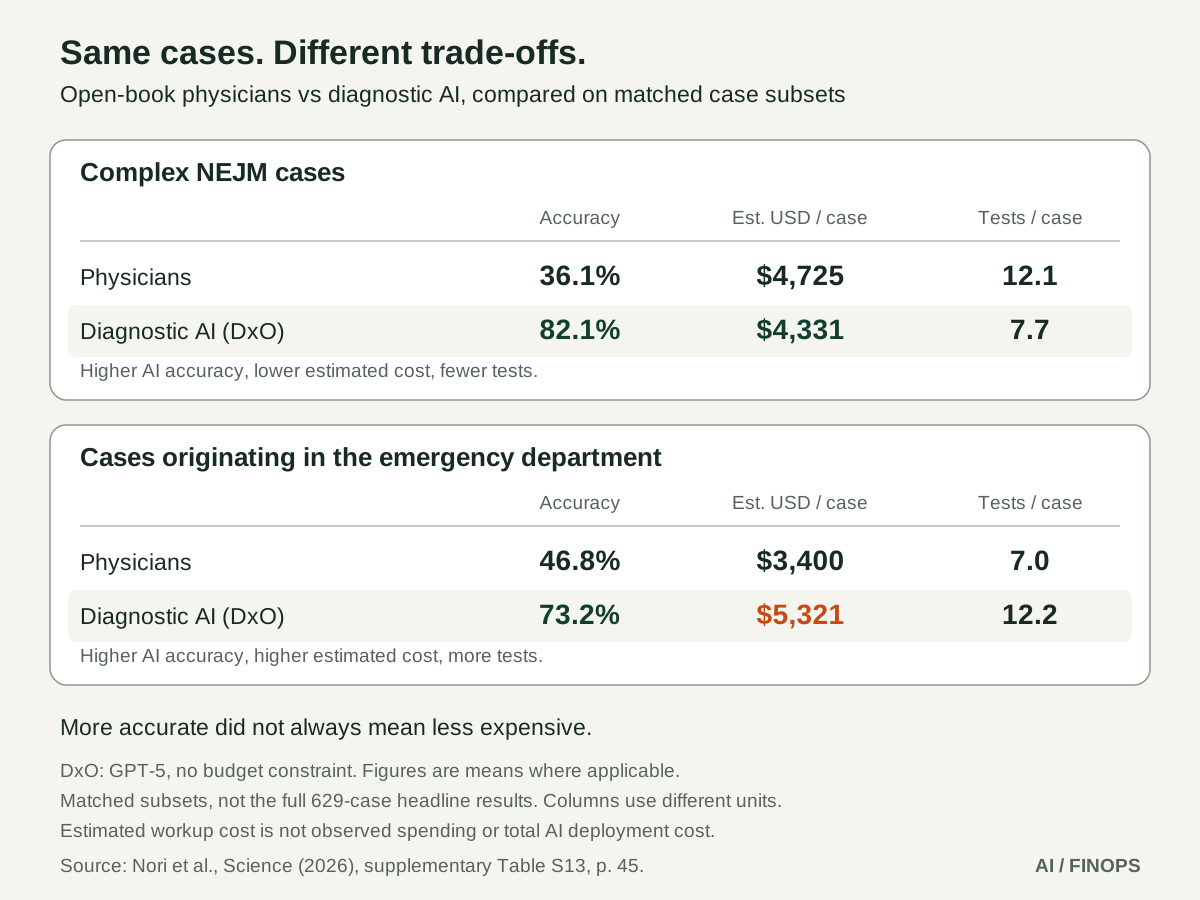
For a direct comparison with physicians, supplementary Table S13 reports matched case subsets. These AI accuracy figures differ from the full-dataset results because they cover different case selections.
On matched complex cases, DxO achieved 82.1% accuracy, compared with 36.1% for physicians. It requested fewer tests: 7.7 versus 12.1 per case. Estimated cost was lower, at US$4,331 versus US$4,725.
The emergency-department comparison tells a different economic story. DxO achieved 73.2% accuracy, compared with 46.8% for physicians. But it requested more tests and incurred a higher estimated cost: US$5,321 versus US$3,400.
These comparisons used GPT-5 DxO without an explicit budget constraint and physicians with access to selected clinical reference resources.
What the cost figures actually mean
No hospital bills were generated by these simulated investigations.
As described in the supplementary cost-estimation methods, researchers mapped requested tests to medical procedure codes and prices from a hospital pricing table. They also assigned US$300 per simulated physician visit. Consecutive questions counted as one visit, ending when a test was requested.
These are standardized estimates for comparing diagnostic strategies, not measured hospital expenditure or a complete operating budget for a deployed AI service.
The model is only part of the system.
The researchers tested several language models, including GPT, Claude, Gemini, and open-weight models. They also examined what happened when structured diagnostic orchestration was added.
On the full complex-case dataset, Table S9 reports that GPT-5 with baseline prompting achieved 78.9% accuracy at an estimated US$8,409 per case. The same model operating through unrestricted DxO achieved 83.2% at US$5,431.
The underlying model did not change. The process around it did.
These figures measure estimated diagnostic-workup costs, not inference charges. The comparison suggests that model selection alone does not explain the economics of an AI workflow.
The FinOps lesson
The useful unit is not simply cost per AI request. It is the cost of the workflow required to produce an acceptable outcome.
A cheap response can trigger expensive downstream actions. Additional reasoning might prevent unnecessary work. A tighter budget might also cause the system to stop before obtaining decisive evidence.
FinOps needs to examine cost and quality together, including integration, clinician time, and oversight when evaluating a real deployment.
This study did not establish clinical safety, treatment benefit, or the performance of physicians working alongside AI. It does not show that AI can replace doctors.
It offers something more specific: evidence that the design of an AI workflow can change both the quality of its decisions and the resources those decisions consume.
Better answers matter. So does the path taken to reach them.