
Microsoft is changing Copilot from a predictable software subscription into a hybrid model: per-user licensing for everyday assistance and metered consumption for advanced agentic work.
The Microsoft 365 Copilot subscription covers routine assistance across Word, Excel, PowerPoint, Outlook, Teams, and Copilot Chat. Advanced work — including Cowork, and eventually Code and Autopilot — moves into Copilot Credits as those capabilities become available.
The subscription pays for assistance. The meter starts when AI receives more time, tools, context, and authority.
The $30 public Copilot seat price has remained since November 2023, but the commercial structure around it has not. Microsoft has repeatedly changed eligibility, billing options, product bundles, and consumption rules.
Buyers are not the only ones still working out how to price AI work — suppliers are too.
First, Separate the Two Copilots
Microsoft Copilot and GitHub Copilot share a company and some underlying technology. They do not share the same product, audience, credits, or billing system.
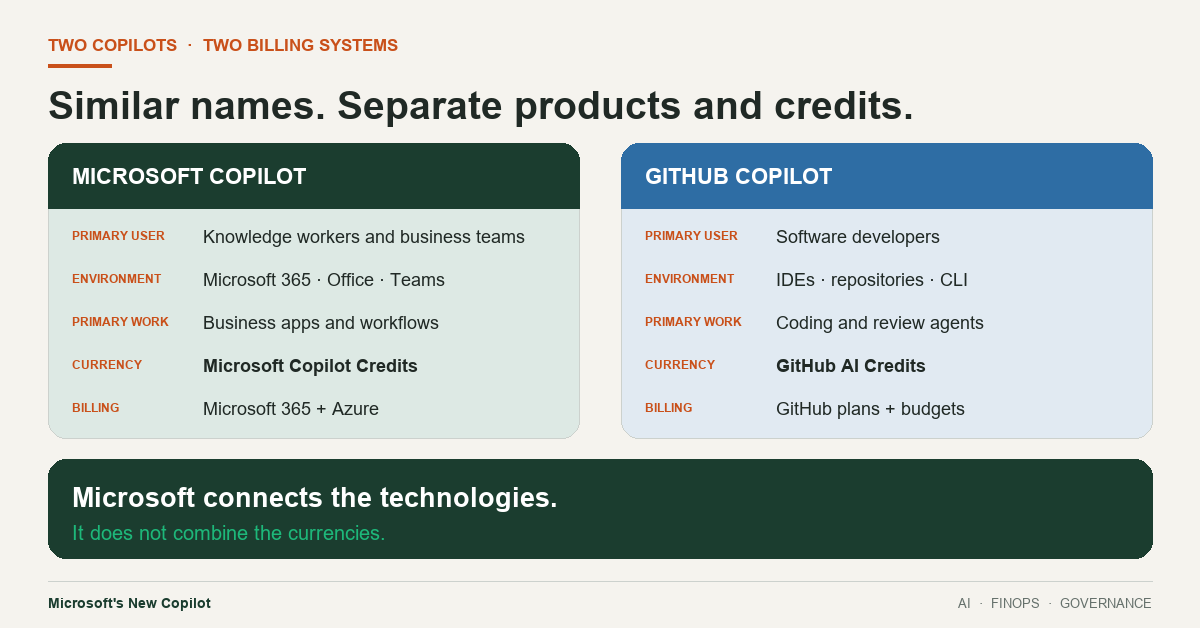
Microsoft Copilot Credits and GitHub AI Credits are separate currencies, even where Microsoft connects Copilot and GitHub technology.
A Simple Annual Cost Scenario
Consider an organization that assigns Microsoft 365 Copilot to 100 employees.
At Microsoft's public enterprise add-on list price of $30 per user per month, paid annually:
100 users x $30 x 12 months = $36,000 per year
That is in addition to the organization's qualifying Microsoft 365 base licenses.
Now suppose the company sets a monthly Cowork limit equal to 300,000 Copilot Credits. At Microsoft's pay-as-you-go list rate of $0.01 per credit:
300,000 credits x $0.01 x 12 months = $36,000 per year
If the organization consumed the full limit every month, the seat and credit costs would total $72,000 per year before base licenses, connected services, governance, and human review.
But a limit is not the same as a bill.
The Limit Is Not the Bill
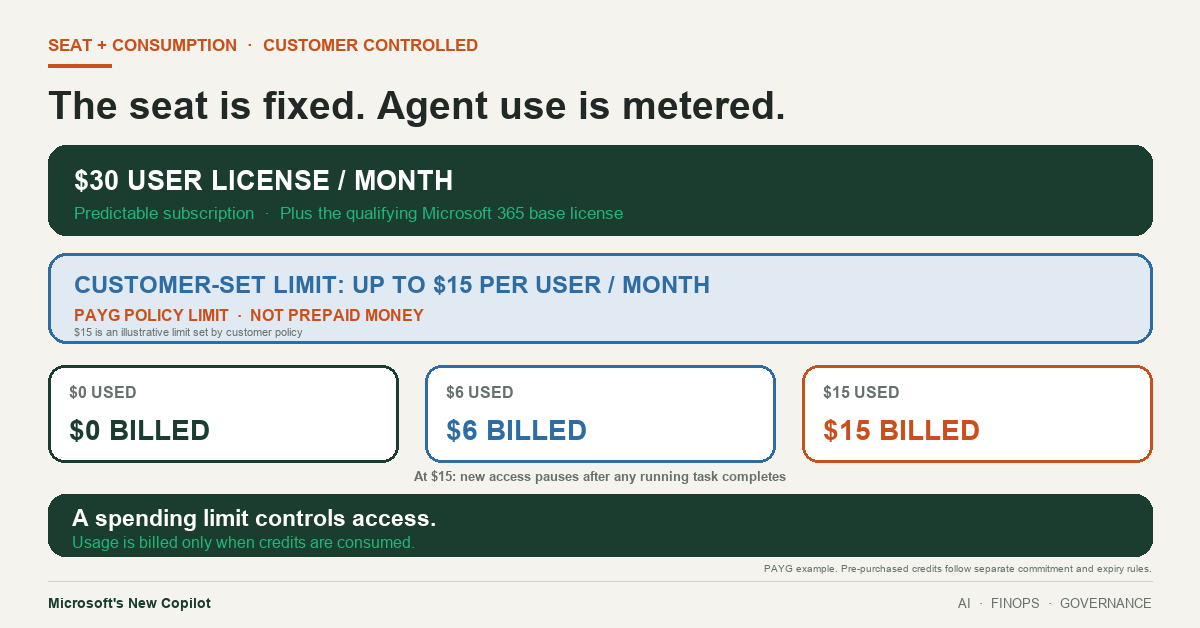
The visual below separates the two parts of the hybrid model.
The $30 user license is a fixed subscription charge. The $15 amount is an illustrative monthly PAYG limit set by the customer through a spending policy. It is not a Microsoft list price, prepaid balance, or automatic charge.
The actual variable bill depends on consumption:
- If the user consumes no credits, the variable charge is $0.
- If the user consumes $6 of credits, the variable charge is $6.
- If the user consumes $15, the variable charge is $15. New access then pauses after any already-running task finishes.
If a user consumes $6 against a $15 limit, the remaining $9 was never purchased. The organization does not pay it.
The visual therefore shows a ceiling, not a forecast.
Pre-purchased Copilot Credits work differently. They involve commitments, discounts, and expiry rules.
Spending Policy Becomes Access Policy
For most enterprise customers, Microsoft keeps usage-based services off until an administrator activates billing and creates a spending policy.
Some newer Microsoft 365 Copilot Business purchases are scheduled to receive usage-based billing by default beginning November 2, 2026. Administrators should verify the configuration rather than assume metered use is disabled.
A spending policy can determine which users and Entra groups receive access, which services they can use, how many credits they may consume, and which Azure billing source pays.
Microsoft also uses two different controls:
- In Cowork Cost Management, a monthly spending limit can restrict access.
- In PAYG billing policies for Copilot Chat and SharePoint agents, a budget triggers notifications but does not necessarily stop usage.
A budget is therefore not always a limit.
Microsoft documents an exception for Cowork users under group spending policies. A task already running may finish after crossing its per-user limit. Microsoft says this excess does not count against the policy limit, does not appear as consumed credits in its Cost Management dashboards, and is not billed at Microsoft's discretion.
The spending policy is therefore an access-control mechanism — but not a hard real-time kill switch.
Governing the Variable Cost
A fixed seat answers:
Who has Copilot?
A spending policy answers a more difficult question:
How much autonomous work may that person authorize?
As Cowork shifts from the Copilot subscription to metered Copilot Credits, FinOps practitioners can help management estimate upcoming costs by establishing an early consumption baseline, grouping users by expected usage patterns, and modelling light, medium, and heavy adoption scenarios.
This requires organizations to decide who receives a variable allowance, how high each limit should be, who can approve exceptions, which department owns the cost, and who remains responsible when an agent continues working.
Copilot Credits show that the system performed work. They do not prove that the work was correct, necessary, or valuable.
References
- Microsoft — Evolution of the Copilot pricing model
- Microsoft — Introducing the new Copilot with Home, Code and Autopilot
- Microsoft Learn — Managing AI experiences enabled by usage-based billing
- Microsoft Learn — Setting up Copilot pay-as-you-go services
- Microsoft Partner Center — September 2026 announcements
- GitHub — Usage-based billing for organizations and enterprises