OpenAI has sharply reduced the price of two models in its GPT-5.6 family, which excludes its flagship frontier model, Sol.
Starting July 30, GPT-5.6 Luna became 80% cheaper, while GPT-5.6 Terra became 20% cheaper. The changes apply to OpenAI's API, which businesses and developers use to add AI to their software. They also apply to subscriptions: Terra and Luna now use up fewer credits in ChatGPT Work and Codex.
OpenAI's Explanation. OpenAI says the savings come from making every part of its AI system more efficient. The company also says Sol helped its engineers find additional savings. Under human supervision, Sol rewrote and optimized important production code, designed experiments, and monitored technical processes. OpenAI says the code work alone cut the cost of serving the model by 20%. According to OpenAI, these improvements allow its systems to complete the same work using less computing power, time, and money.
Part of a Much Larger Trend. The cost of using AI models has been falling rapidly across the industry. Stanford University's 2025 AI Index found that the cost of using a model with performance comparable to GPT-3.5 fell from $20 per million tokens in November 2022 to $0.07 by October 2024. Stanford called that a reduction of more than 280 times. The comparison uses models scoring at the same level on a common benchmark, not the same model over time.
OpenAI's price cuts are therefore not an isolated event. They are part of a broader decline driven by better hardware, more efficient software, specialized models, and stronger competition.
Open Models Are Increasing the Pressure. Open-weight models are the bigger squeeze. Stanford's 2026 AI Index found the best closed model still leads the best open model, but by only 3.3%. OpenRouter, a service that routes requests across many AI providers, reported that open-weight models grew to about a third of all the tokens it handled by late 2025.
Quality is now close enough that cost decides. OpenAI's chart uses the Artificial Analysis Intelligence Index, the same scorecard OpenRouter uses. On that index in June 2026, the top open model, GLM 5.2, scored 51 — about five points below Claude Fable 5. And OpenAI's chart plots Luna directly against open and Chinese models like DeepSeek V4 Pro, GLM-5.2 Max, and MiniMax, alongside its usual rivals at Google and Anthropic. That is the field it is pricing into.
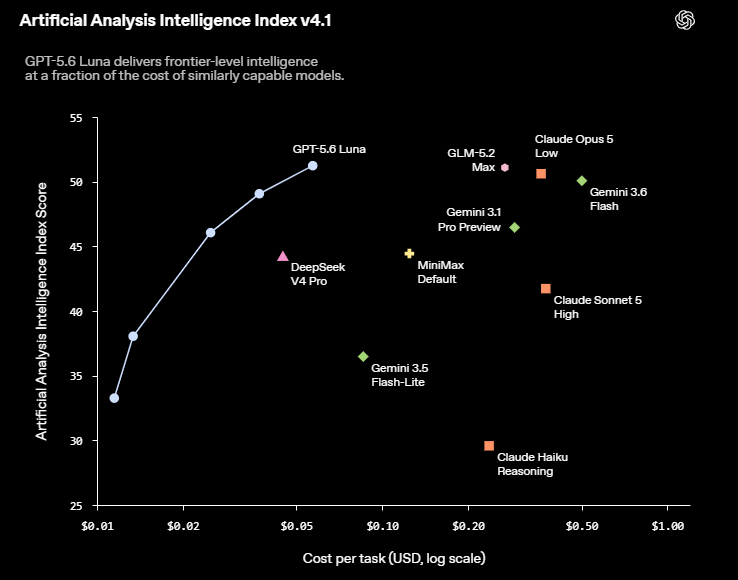
Why OpenAI Is Cutting Prices Now. When lower-cost alternatives are good enough for everyday work, premium AI providers must give customers a clear reason to pay more. Better engineering gave OpenAI room to lower its prices. Competition likely gave the company a reason to pass those savings on to customers now.
What Happens Next. OpenAI's competitors will likely review their own pricing, but it is too early to know whether Anthropic or Google will respond within days or weeks.
AI companies are no longer competing only to build the smartest model. They are increasingly competing to offer the best combination of quality, speed, security, and price.
References
- OpenAI — "Advancing the price-performance frontier with GPT-5.6" (July 2026)
- Stanford HAI — 2025 AI Index Report, Ch. 2: Technical Performance
- Stanford HAI — 2026 AI Index Report, Ch. 2: Technical Performance (PDF)
- OpenRouter — State of AI
- OpenRouter — "The Open Weight Models that Matter: June 2026"