Bloomberg reported that Stripe agreed to buy OpenRouter for more than $7 billion. Neither company had confirmed the deal when this was written, so the price and terms may change.
If the deal happens, the key question is not why Stripe wants an AI model company. OpenRouter does not build models. The better question is why Stripe wants to sit between AI models and their users.
Stripe appears to be buying a position in the AI value chain. It is not trying to beat OpenAI, Anthropic, Google, Microsoft, Amazon, or NVIDIA at models, chips, or cloud computing.
OpenRouter gives developers one place to reach hundreds of models. Each model has a different price, speed, quality, and level of trust. More choice creates more work. An abstraction layer can hide much of that work. It can compare providers, route requests, handle failures, and combine bills.
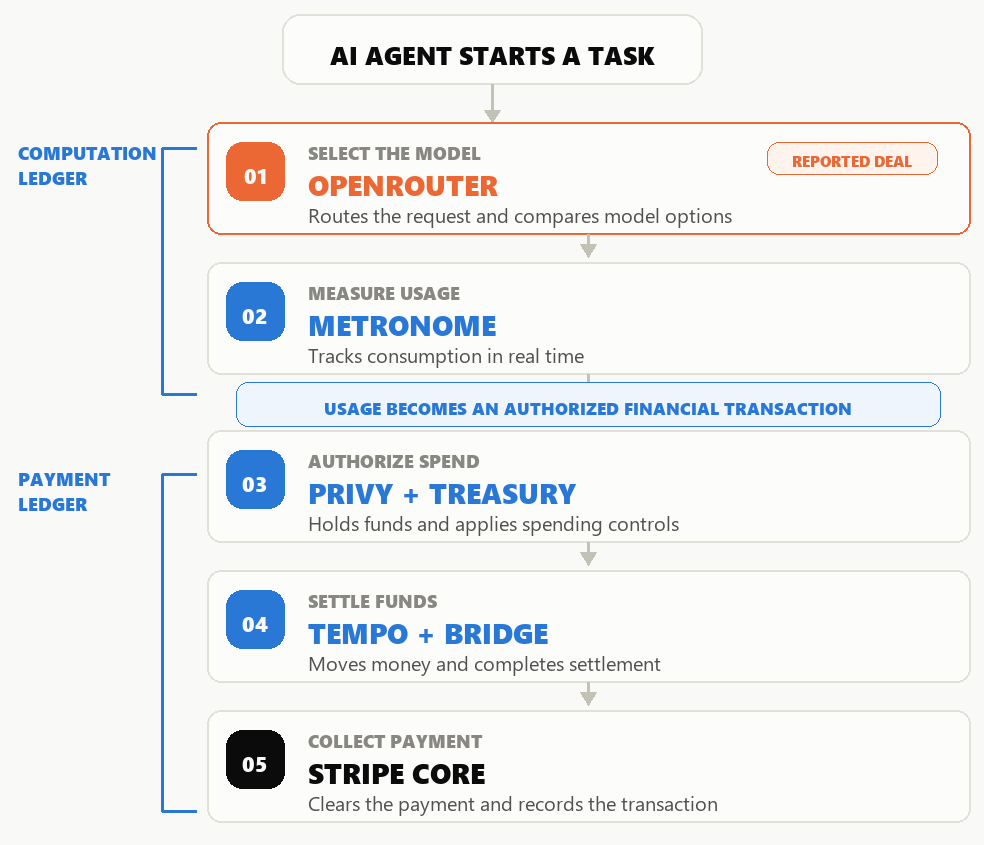
OpenRouter fits a larger Stripe plan. Metronome measures usage. Privy manages digital wallets. Bridge and Tempo help move money. Stripe is also building infrastructure for agentic commerce. Its tools can help AI agents find products, make purchases, and handle payments.
OpenRouter could add model access and routing to that stack. Together, these tools could let Stripe route an AI request, measure it, approve payment, and settle the bill. "Could" matters — Stripe has not announced one joined system.
The routing data may be as strategically important as the routing itself. OpenRouter sees model and provider choices made through its service. Stripe might use that traffic to study switching, price changes, and model demand.
Those are possible uses, not confirmed rights. Contracts and privacy rules may limit what Stripe gets or how it uses the data. OpenRouter also sees only its own traffic. It cannot see direct purchases or models run inside a company.
The economics look attractive, but the percentages need care. OpenRouter lists a 5.5% fee on many credit purchases. One outside estimate puts Stripe's 2025 revenue near $6.8 billion. Stripe says it processed $1.9 trillion that year. That works out to about 0.36%.
These are not equal margins. The stronger point is that Stripe's payment business has huge volume and thin economics. An AI service may earn a higher rate from a much smaller base.
The main risk is trust. Stripe owns no major model and runs no hyperscale cloud. That may make it more neutral than a model lab or cloud provider when choosing models.
But Stripe has financial products to sell. It could also shape routing, payment, and money flows. It may be model-neutral but not economically neutral.
If customers become worried, they can leave. Large buyers can connect to providers directly. Stripe is not buying a locked gate. It is buying a useful place in the road.
My read is simple: Stripe wants to coordinate the AI economy without controlling every part of it. The strategy works only if Stripe stays useful to every side — and avoids becoming a threat to any one of them.
References