When a classifier misses an important distinction, more instructions are the obvious first response — but not always the right investment.
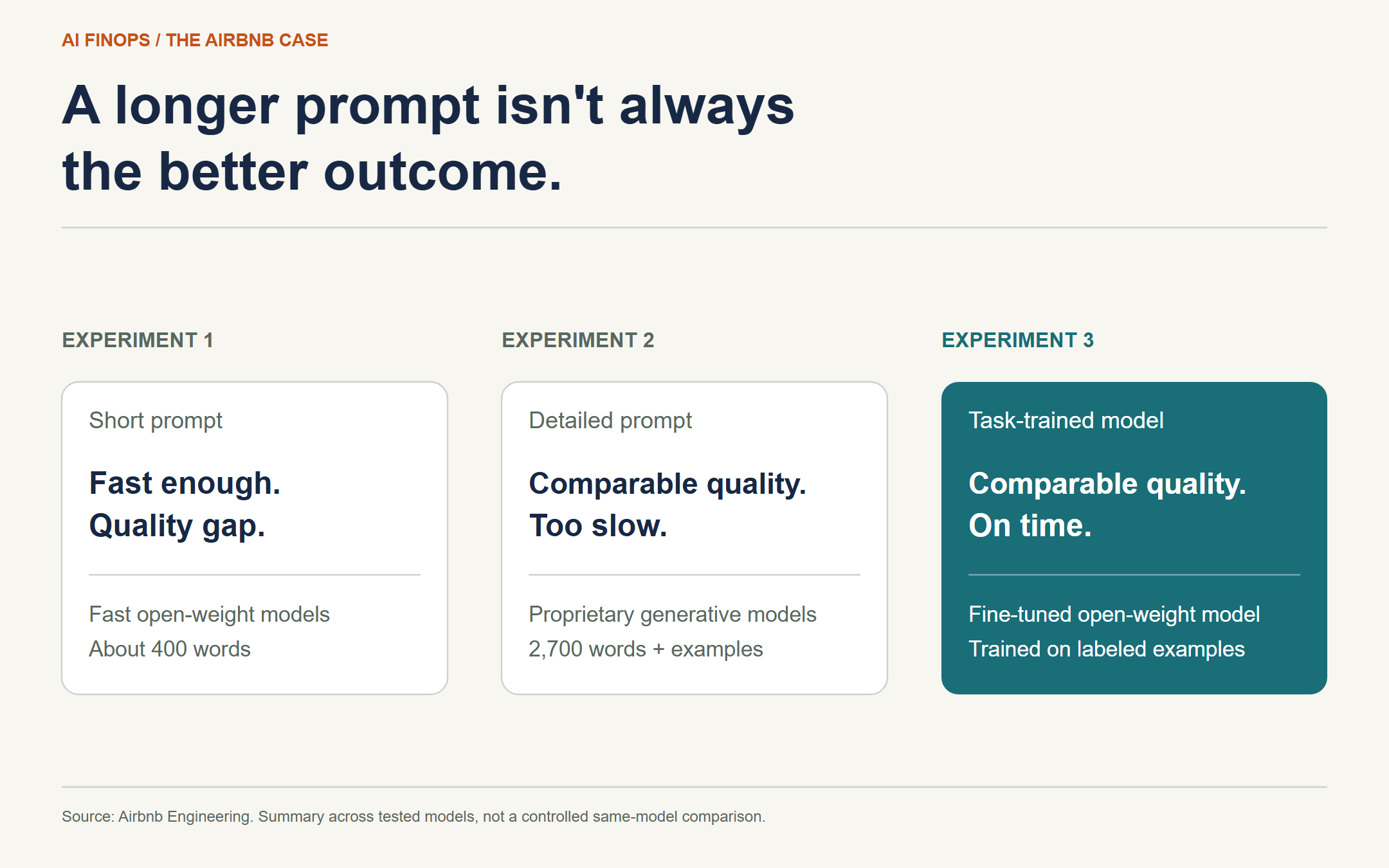
Airbnb's November 2026 benchmark identified a production trade-off: models that reached comparable quality with detailed prompts were too slow for its latency budget; models within that budget gained only modestly and retained a substantial quality gap.
The deadline changes the comparison.
Airbnb screens pricing and payment-transparency violations, where false positives block legitimate content. Thousands of calls per minute must return a score within 200 milliseconds. Quality, latency, and serving cost must be evaluated together — not model size alone.
Training Gemma4-E2B — two billion effective parameters — on hundreds of thousands of domain-specific examples raised max F1 — the best result across decision thresholds — from 0.563 to 0.902. Median latency stayed at 35 ms, with p99 around 85 ms.
GPT-6.1 Sol and Claude Sonnet 5.5 each took about 900 ms at the median, even in low-thinking mode, with p99 in seconds. Faster vendor tiers exist, but at a premium.
Airbnb tested a roughly 400-word prompt and a detailed 2,700-word prompt containing worked examples. With detailed prompting, proprietary generative models gained one to three points and roughly matched the trained classifier's quality, but at much higher latency.
Research supports testing the alternative.
Liu and colleagues' 2022 T-Few study compared T-Few, an 11-billion-parameter model, against few-shot in-context learning with GPT-3 175B, roughly 16 times larger. T-Few achieved better classification results with lower estimated inference compute — not measured production bills.
Mosbach and colleagues' 2023 study matched model size and example count. Both approaches generalized similarly, but performance varied substantially with model size and example count. Its few-shot experiments included OPT models up to 30B. Predating today's frontier models and long-context capabilities, these studies support testing fine-tuning, not making it the default.
Shopify shows why task design matters.
In its ICLR 2025 account, Shopify describes fine-tuning smaller vision-language models for product classification and attribute extraction because commercial APIs were prohibitively expensive at its volume. Humans establish evaluation labels; an LLM arbitrator, with human fallback, selects training labels from model-generated suggestions.
Requiring all fields during training reduced generalization. Randomly varying the requested fields improved flexibility; selective instructions then controlled production outputs. Shopify reports median latency falling from 2 seconds to 500 ms and GPU usage dropping 40%. It also measures field compliance and field invariance — whether requesting additional fields changes answers to fields already requested. In effect, training and selective prompting worked together.
Measure the operating decision, not just the headline score.
Scores give operators a control surface: they can adjust false-positive tolerance without rewriting prompts. Airbnb swept decision thresholds for score-returning models and reported their best F1 on the evaluation set, while verdict-only models supplied one fixed operating point.
The evaluation used 10,000 held-out examples weighted to correct production sampling. F1 combines precision and recall, not percentage accuracy. Airbnb reports nearly unchanged rankings under other available metrics. A production threshold still needs separate validation.
The AI FinOps question is when to change the investment.
Airbnb estimates serving costs at roughly 1% of frontier-API costs at high volume; detailed prompts added another 20–40% to frontier-model costs. Below roughly 15–30 requests per minute, Claude Sonnet 5.5 and GPT-6.1 Sol were cheaper than a dedicated GPU.
Airbnb's comparison covers serving cost only: October 2026 API list prices, public rental rates for one self-hosted NVIDIA RTX Pro 6000 GPU, and a 71% cache-hit assumption favoring hosted models. Labeling, training, evaluation, and operations remain additional investments. One task at one company does not establish a universal break-even.
Prompting may remain preferable when tasks change, labels are scarce, or traffic is low. Otherwise, test whether a training pipeline earns its investment.
Compare fully loaded cost per correct decision delivered within the latency SLA, including failed attempts and the measured cost of errors. A late result is a failure; retries and fallbacks remain part of the cost. Enforce separate false-positive and false-negative limits.
The question is which investment lowers the cost of a correct decision delivered by the deadline.
References
- Airbnb: Frontier quality at 1% of the cost
- Liu et al.: Few-Shot Parameter-Efficient Fine-Tuning is Better and Cheaper than In-Context Learning
- Mosbach et al.: Few-shot Fine-tuning vs. In-context Learning: A Fair Comparison and Evaluation
- Shopify: Leveraging multimodal LLMs for Shopify's global catalogue