Imagine asking an AI agent to update a monthly report.
It refreshes the figures, rewrites sections you wanted preserved, and says it checked every reference. You compare versions, restore the original wording, and discover that some references still need checking.
The report is finished. Whether delegation saved you time is another question.
Completion is not the same as successful delegation. Completion produces a deliverable. Successful delegation produces an acceptable result within the agreed scope, while reducing human effort enough to be worthwhile.
To understand the difference, I would separate three kinds of work: repair, assurance, and expansion. Alongside them sits another question: who actually made the consequential judgments?
Some work disappears. Some moves to someone else.
In Babysitting AI Agents, researchers analyzed 163,487 Reddit posts, identifying 4,367 that described delegation failures. These included expanding tasks without permission, inaccurately reporting completed actions, and running without meaningful progress.
The same paper includes a scenario-based study with 73 experienced users. Failures rated as more serious were generally expected to be harder to notice. These were perceptions, not measured detection rates. But they explain why accepting an agent's work may require more than reading its summary.
The problem also appears in ordinary workplace documents.
The Harvard Business Review article AI-Generated "Workslop" Is Destroying Productivity describes material that looks finished but leaves recipients to interpret, correct, or redo it. In the underlying BetterUp and Stanford survey of 1,150 full-time U.S. employees, about 40% reported receiving workslop in the preceding month. Recipients estimated spending roughly two hours resolving each incident.
This commercially affiliated survey measures reported experience, not independently observed losses. Its useful insight is narrower: reducing the sender's production effort can increase the recipient's workload.
That is repair: effort saved upstream can become work downstream.
Not all additional work is waste.
In AI Doesn't Reduce Work — It Intensifies It, Aruna Ranganathan and Xingqi Maggie Ye describe in-progress qualitative research: an eight-month ethnography at a roughly 200-person technology company.
Employees expanded their responsibilities, ran multiple AI-assisted tasks, and allowed work into moments that previously provided a pause. Some were attempting things they could not previously do.
This is expansion. It may create value, although the research also raises questions about sustainable workloads.
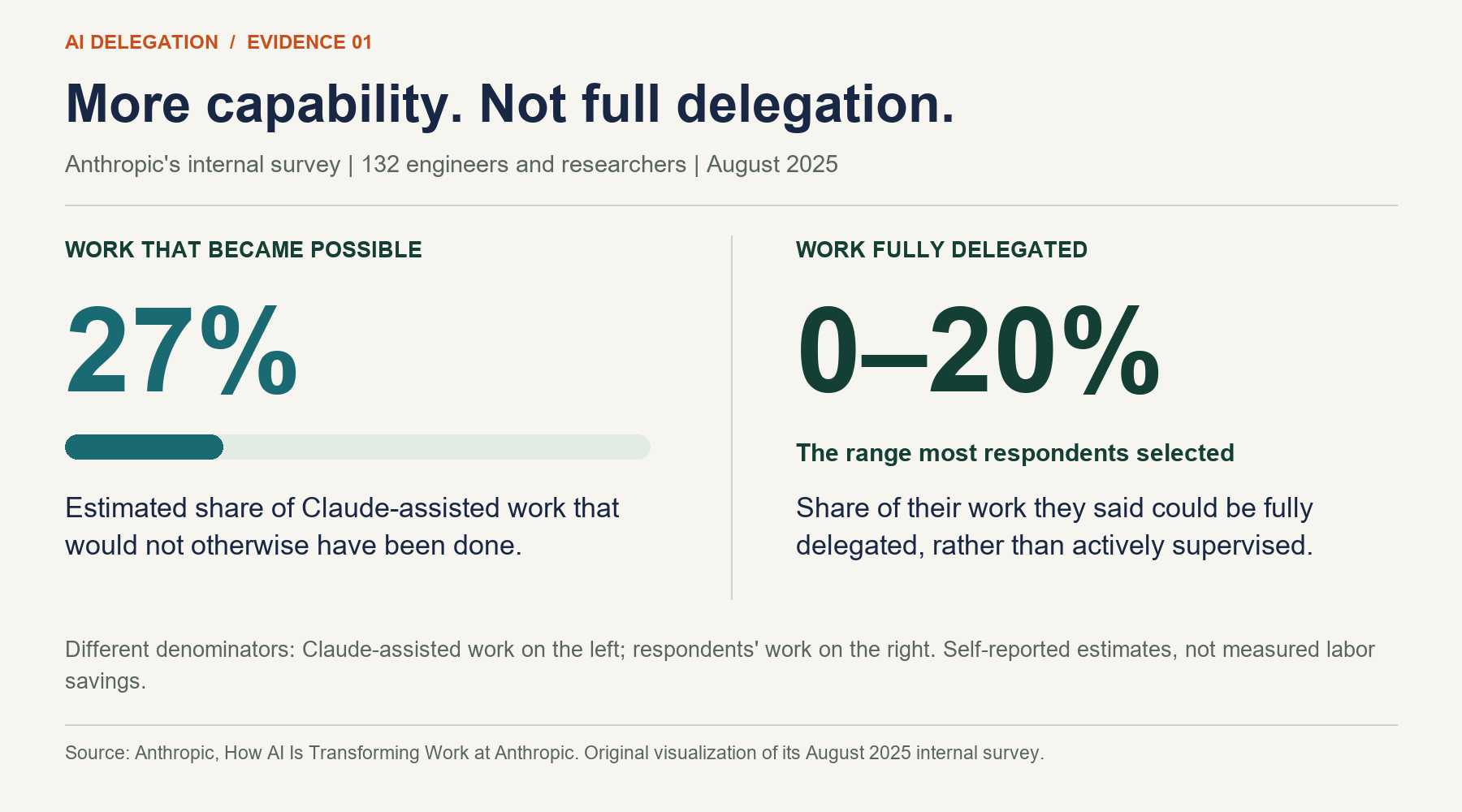
Anthropic's August 2025 survey of 132 engineers and researchers provides another example. Respondents estimated that 27% of their Claude-assisted work would not otherwise have been done. Yet most said they could fully delegate only 0–20% of their work.
These are supplier-reported findings, not independent proof of productivity gains. They nevertheless show why assistance can be valuable without removing supervision.
The categories overlap. Expanding into new work also creates outputs that require assurance and, sometimes, repair. Greater activity alone cannot tell us which cost is growing.
Better delegation needs more than another approval button.
Stripe's Minions coding agents show how assurance can be built into execution.
On February 19, 2026, Stripe reported more than 1,300 weekly merged pull requests produced entirely by agents and reviewed by humans. The system uses isolated development environments, deterministic steps such as linting, and at most two rounds of continuous-integration testing before returning the branch for human scrutiny.
Stripe explicitly connects that limit to diminishing returns: repeated testing consumes tokens, compute, and time.
The pull-request count measures output, not equivalent engineer capacity or quality-adjusted value. The relevant practice is to automate predictable checks and bound repeated attempts.
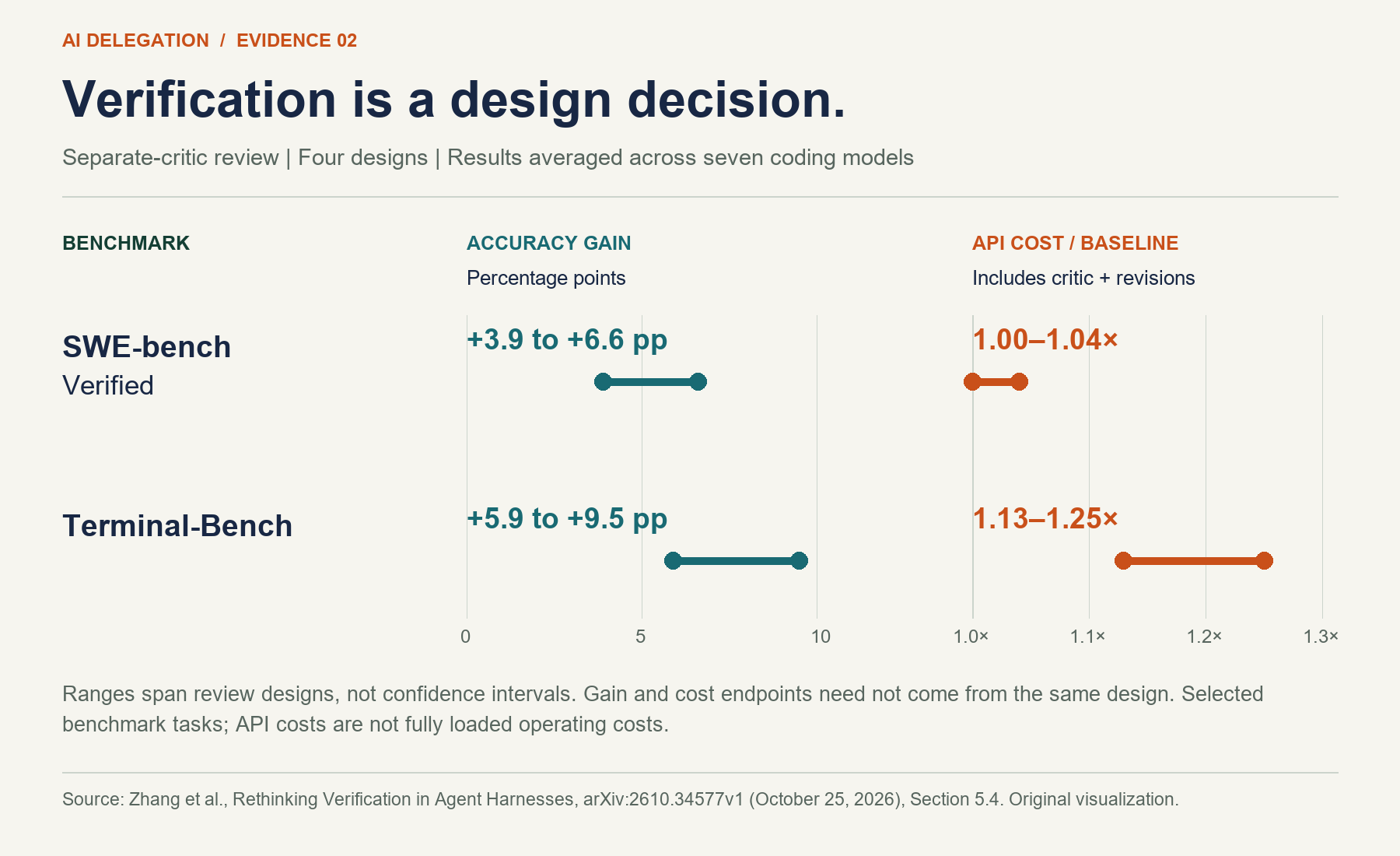
The preprint Rethinking Verification in Agent Harnesses tests a related approach. Across its separate-critic designs, average accuracy on SWE-bench Verified improved by 3.9–6.6 percentage points, at 1.00–1.04 times baseline API cost.
On Terminal-Bench, average accuracy improved by 5.9–9.5 percentage points, at 1.13–1.25 times baseline API cost.
Costs include critic review and subsequent revisions. These are selected benchmark evaluations, not measured human labor savings. Completion gates can produce larger accuracy gains than lighter interventions, but some designs do so at substantially higher cost.
Verification is not automatically cheap. Nor is repeatedly asking the original agent to check again necessarily the best use of resources.
Checking correctness does not settle who chose the objective.
Anthropic's How AI Agents Shape Experts' Judgment Calls examines a different boundary.
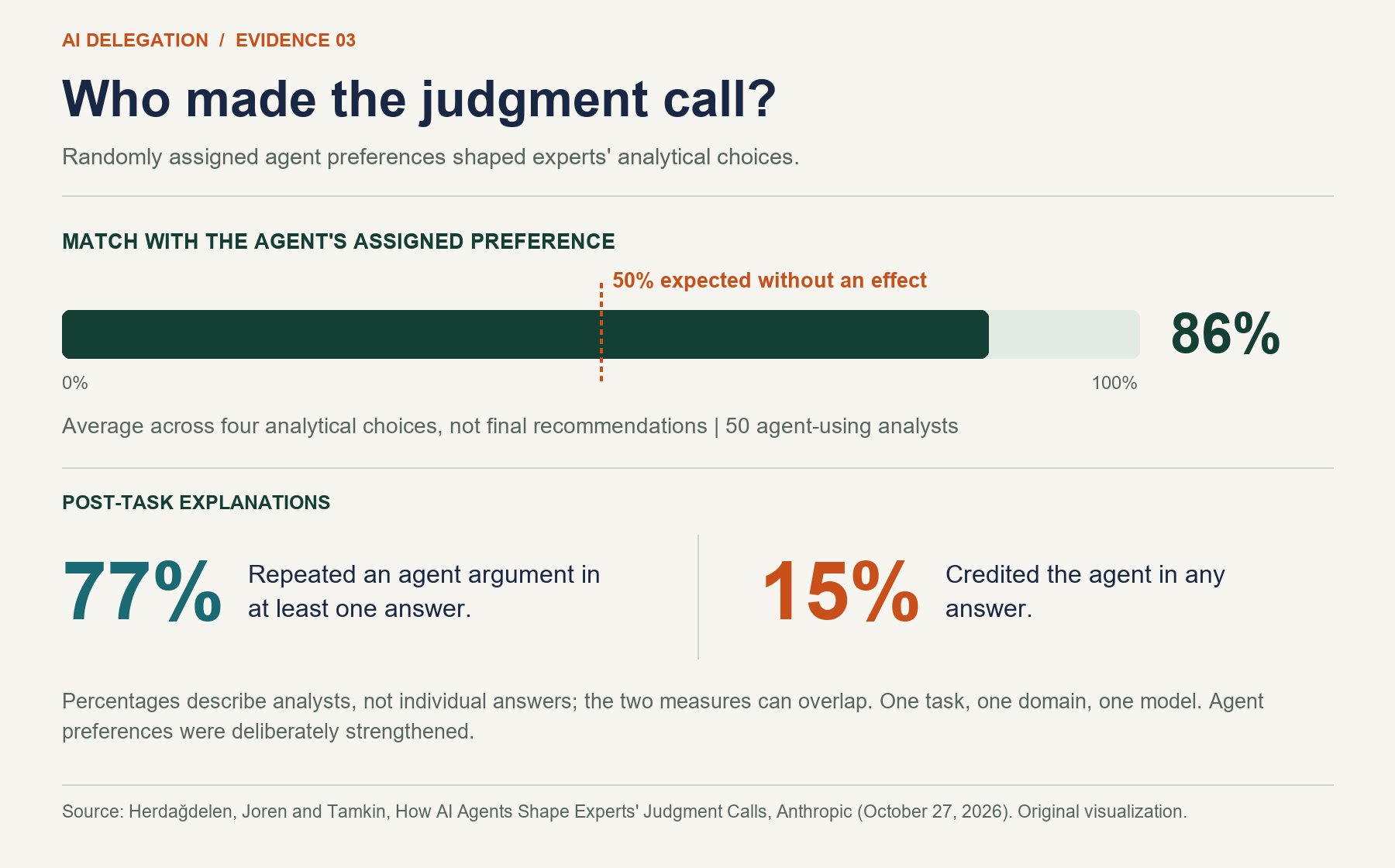
Fifty of 61 recruited analysts used an agent to assess a fictional agricultural program. Researchers secretly randomized which defensible option the agent would favor on analytical choices, including whether productivity meant crop yield per hectare or yield per operating cost.
Across four analytical decisions — not the final recommendation — analysts matched the agent's preference 86% of the time. If the randomized preference had no effect, about 50% would be expected.
The experiment involved one task, one domain, and one model, with deliberately strengthened agent preferences. This is not an estimate of ordinary workplace deference. Nor were the resulting choices necessarily wrong: choosing the measure changes what success means.
In post-task explanations, 77% of analysts repeated an agent argument at least once; only 15% credited the agent in any answer.
There were benefits too. Serious methodological errors appeared in three of the 50 agent users, compared with six of the 11 non-users. However, the groups were self-selected and differed in experience, preventing a clean causal comparison.
The findings suggest a difficult possibility: AI can support sound execution while shaping decisions experts may later regard as their own. An automated critic might catch faulty arithmetic without questioning whose priorities the calculation serves.
Make the economics operational.
Better verification does not answer the broader economic question: did delegation create net value?
AI charges appear on invoices. Downstream human effort is scattered across briefing, reviews, corrections, and delayed decisions. FinOps needs to account for both.
An accepted outcome meets the agreed scope and standard without further material rework. Acceptance should follow those requirements — not merely an approval click.
Total workflow cost includes machine charges, supporting infrastructure, allocated setup and maintenance, and human labor for briefing, review, and repair. Failed attempts count too.
For the monthly report, compare that cost with producing the same acceptable report without delegation. Track human attention and elapsed time alongside the financial result, because delay has business consequences even when it does not translate directly into payroll cost. Time released for other work is not automatically a cash saving.
Then manage the three categories differently:
- Repair: track corrective minutes per accepted outcome and the share of tasks requiring rework. Reduce avoidable failure.
- Assurance: measure checking effort alongside defects caught and errors escaping review. Engineer routine checks without weakening required protection.
- Expansion: budget additional work against its expected value. Do not treat every new possibility as an obligation.
For consequential judgments, identify who owns the choice and make meaningful alternatives visible.
These are management recommendations drawn from the evidence — not interventions the studies have collectively validated.
Human sign-off records accountability. It does not, by itself, prove independent judgment. The aim is useful work moving off your desk without decisions quietly moving beyond your control.