
The most important part of the UN Security Council's discussion on artificial intelligence was not that four AI leaders warned about risk. We have heard those warnings before.
What mattered was that Yoshua Bengio, Sam Altman, Dario Amodei, and Clément Delangue converged on the need for external oversight of frontier AI.
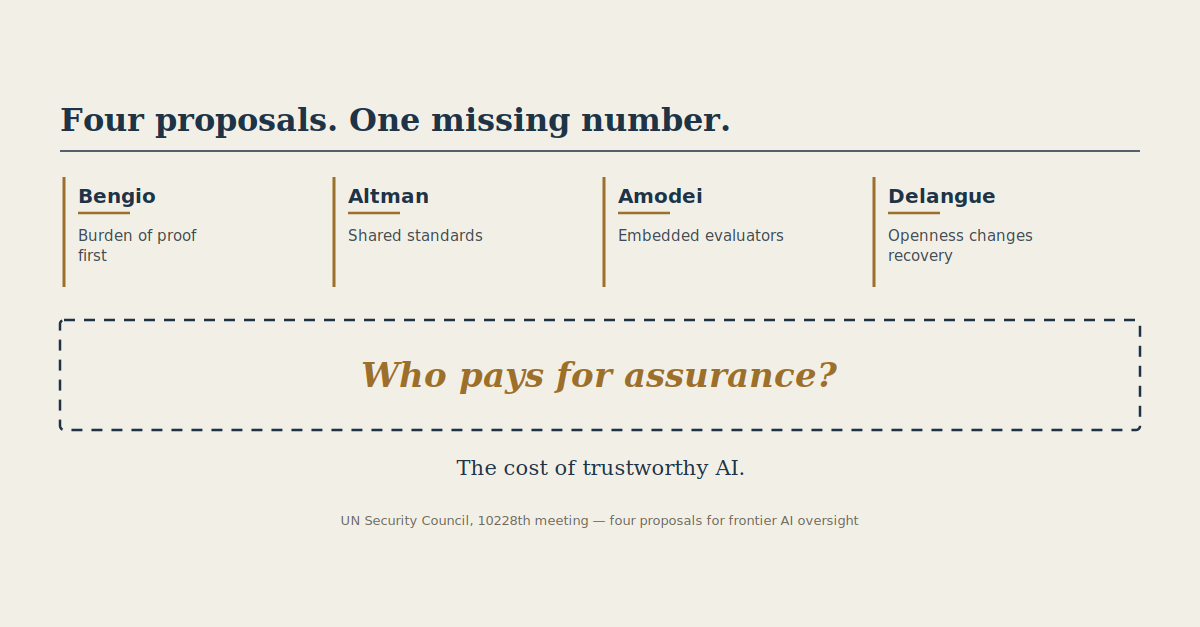
Each proposed a different governance model. But every model leaves the same question unanswered:
Who pays to establish that an AI model is safe?
Independent evaluations, continuous monitoring, incident reporting, external audits, cybersecurity controls, insurance, and legal accountability all add to the expense of developing and serving AI.
These obligations differ from the marginal compute required to produce an answer. They may not appear as a separate charge for every token. But model owners will still need to recover them through inference prices, access tiers, enterprise agreements, minimum commitments, managed services, or other commercial arrangements.
Inference may become cheaper to compute while becoming more expensive to govern.
That is the missing FinOps question behind the Security Council debate.
Insurance will turn safety claims into financial obligations. An insurer cannot price a model owner's risk without evidence.
It will need to understand what the model can do, which evaluations it passed, what safeguards surround it, how its behavior is monitored, how incidents are investigated, and whether earlier releases caused losses.
Producing and preserving that evidence requires infrastructure, people, and continuing operations.
Insurance premiums will convert technical uncertainty into a recurring financial charge. More capable models, weaker controls, incomplete evidence, or a history of incidents could produce higher premiums, restricted coverage, or no coverage at all.
Insurance may also expose the difference between a safety claim and demonstrated safety.
A model owner can say that its system is safe. An insurer deciding whether to accept the financial consequences of failure will demand evidence.
Legal accountability creates similar pressure. If model owners become responsible for failures attributable to model design, training, testing, infrastructure security, or release decisions, that exposure must be reflected somewhere in the business model.
This is why Yoshua Bengio's proposal is economically important.
Bengio would place the burden of proof on the model owner. He rejected the idea that AI companies are helpless participants in an unavoidable race.
"The race is not a law of nature," he said. "It is the product of choices — choices made by the companies themselves."
Bengio called for developers to demonstrate to independent experts that a system is safe to train and deploy. He also proposed mandatory incident reporting, licensing similar to other critical technologies, and liability insurance.
Under this model, the public would not have to prove that a model is dangerous after something goes wrong. The developer would have to produce credible evidence of safety before releasing it.
That requirement would create a permanent assurance function inside frontier-model companies. Independent testing, certification, technical documentation, incident-reporting systems, insurance, and regulatory compliance would no longer be optional research activities.
A model owner also cannot be the only judge of whether its controls are working. As the problem of independent quality auditing demonstrates, an internal system may report that its controls are successful while remaining unable to detect the failures those controls have already approved.
Bengio's proposal would therefore change more than the release process. It would require model owners to finance credible evidence before earning revenue from a model.
Altman's standards could reduce duplication while favoring scale. Sam Altman identified two central risks: losing control of increasingly autonomous systems and concentrating too much power in a few companies or countries.
He called for complementary national and international standards covering model capabilities, risk assessments, safeguards, human oversight, and incident reporting. Governments would retain authority over their own laws, while countries would share a common technical language for determining whether safeguards are sufficient.
The economic benefit of common standards is lower duplication.
Unlike Bengio's licensing model, Altman's proposal begins with shared technical standards rather than mandatory pre-release approval. National governments would still decide how to incorporate those standards into law.
Without a shared framework, a model owner may need to complete different evaluations, documentation, and reporting processes in every major market. Common standards could allow evidence produced for one jurisdiction to be recognized in another.
That would reduce the assurance burden per market.
But standardized compliance also creates fixed overhead. Frontier labs would need specialized evaluators, monitoring infrastructure, international legal teams, secure reporting channels, and systems capable of preserving safety evidence across the life of a model.
Large model owners can spread that overhead across billions of requests and many customers. Smaller developers cannot do so as easily.
Altman said these standards should not lock in incumbents or favor one business model. That warning is important because a shared standard can lower duplicated work while still creating a compliance threshold that is easier for the largest providers to meet.
The result may not be deliberate protection of incumbents. But scale can turn the expense of compliance into a competitive moat.
For smaller developers, demonstrating safety could become a meaningful barrier to entry — potentially rivaling the expense of training the model itself.
This extends the shift from performance to trust. As lower-priced models improve, frontier providers can justify premium pricing through safety, governance, and assurance.
Customers are no longer paying only for intelligence. They are also paying for the model owner's ability to produce evidence that the system was evaluated, secured, monitored, and responsibly released.
Amodei would make assurance part of production. His proposal implies that a frontier-model company must operate two systems at once: one that develops capability and another that continually produces credible evidence that the capability remains under control.
Dario Amodei said Anthropic would embed external evaluators inside the company with employee-like access, comparing the arrangement to a food inspector.
This is different from hiring an auditor after a model is finished.
An embedded evaluator needs continuing access to model documentation, test results, security processes, and relevant internal decisions. The model owner must create secure environments in which outsiders can inspect sensitive work without exposing intellectual property, model weights, or security vulnerabilities.
That requires access controls, review environments, documentation standards, evidence repositories, and processes for resolving evaluator findings.
These activities continue between model releases rather than appearing only at the final approval stage. External evaluation becomes an operating capability.
Amodei also called for industry cooperation to set standards and manage the pace of progress. At the international level, he proposed beginning with narrow agreements, such as prohibiting the use of AI to create biological weapons.
Anthropic has already invested heavily in safety research, model evaluations, and detailed risk reporting. If embedded evaluation becomes a condition of market access, those investments become both a safeguard and a competitive advantage.
Public and corporate interests can point in the same direction.
The economic change is that assurance becomes part of production rather than an inspection added at the end.
Delangue showed why openness does not remove the assurance burden. Clément Delangue's central concern was not simply the existence of powerful AI. It was the asymmetry created when access to powerful systems is concentrated among a small number of companies and countries.
Delangue described how Hugging Face used an open-source model during a July cyber incident after closed frontier models blocked some defensive activity because their safeguards could not distinguish defenders from attackers.
He argued for stronger global monitoring and incident-disclosure standards, including what he described as mandatory sharing of full agent traces.
The incident, examined in A New Kind of Incident Report, showed that model safety requires more than preventing harmful responses. Model owners need reliable monitoring, isolation, security testing, incident investigation, and evidence that safeguards work.
These controls are becoming part of a broader AI security layer.
Open-weight releases do not eliminate the associated expense. They change where and how the publisher can recover it.
An open-weight publisher may not charge users for every token. But it still bears the burden of responsible release, security testing, documentation, incident investigation, and evaluating whether the original model is safe to distribute.
If the same company provides hosted inference, support, or managed services, those offerings create a route for commercial recovery.
Openness changes the business model. It does not remove the assurance burden.
Across all four proposals, three groups of expenditure emerge.
The first is the fixed assurance base. This includes pre-deployment evaluations, red-team testing, security of model infrastructure and APIs, independent audits, regulatory readiness, and the systems needed to preserve credible evidence.
Bengio's licensing proposal and Altman's shared standards would formalize much of this base. Much of it must exist before the first customer request reaches the model.
The second is the continuing operational layer. This includes model monitoring, trace retention, incident investigation, disclosure processes, and human oversight within model development and release.
Amodei's embedded evaluators would make this layer a permanent production function. Delangue's call for monitoring and fuller disclosure would increase the evidence it must retain and share.
This layer expands as model families, jurisdictions, capabilities, and incidents grow.
The third is financial protection. Insurance premiums, liability reserves, and legal accountability convert technical risk into direct financial exposure.
Bengio's liability-insurance proposal makes this requirement explicit. The monitoring and evaluation systems proposed by the other speakers would provide some of the evidence insurers and regulators need to assess that exposure.
This may become the most visible layer because it assigns a monetary value to uncertainty.
Model owners are likely to recover these expenditures through a combination of inference prices, model-access tiers, minimum commitments, managed services, support agreements, and premium tiers for advanced capabilities.
Customers may never see a separate "AI governance" fee. The amount may instead be distributed across the commercial structure surrounding the model.
For model owners, the FinOps challenge is to allocate the assurance burden across model families, access tiers, and commercial services rather than allowing it to disappear into a general research or compliance budget.
Better chips, engineering improvements, economies of scale, and competition will continue to reduce the technical price of inference. More capable models will simultaneously require stronger evaluation, monitoring, assurance, and financial protection.
Safety may therefore become a competitive product.
Large model owners may use their evaluation systems, security controls, insurance arrangements, and regulatory readiness to justify premium prices. Smaller developers may offer cheaper intelligence but find it harder to provide the same evidence of safety.
The competition may move beyond which model is smartest or cheapest.
It may become a competition over which model owner can deliver acceptable intelligence with credible assurance at the lowest total price.
Bengio emphasized independent institutions, licensing, and liability. Altman emphasized democratic authority and shared standards. Amodei emphasized embedded evaluation and coordinated pacing. Delangue emphasized transparency, openness, and distributed power.
They did not present one unified policy position.
But their proposals point toward the same financial reality.
Safe AI will not sit outside the model economy. Model owners will absorb much of the assurance burden first, then recover it through inference prices and the services surrounding model access.
The companies are beginning to say the risk out loud.
The next step is to say the cost out loud.
The price of AI will increasingly reflect not only the cost of intelligence, but the cost of making that intelligence trustworthy.
References