In AI and the Future of Enterprise Software, I argued that AI may change how employees use business applications before it replaces those applications.
The next question is where competition moves when the applications stay.
There are three layers. Business applications maintain authoritative records and enforce their rules. A coordination layer routes tasks between agents and applications. A control plane governs those agents through identity, permissions, policy, and monitoring.
One supplier may occupy several layers. But owning the application is no longer the only route to a stronger customer relationship.
The prize is the work that connects applications
Consider an employee investigating a delayed customer order. Resolving it may require a customer record, a warehouse update, an invoice, and a promise made in an email.
An agent could gather those details, identify the problem, propose a resolution, and request approval. The existing applications still hold the records and validate changes. Another layer coordinates what happens next.
That coordination layer is becoming a new point of competition.
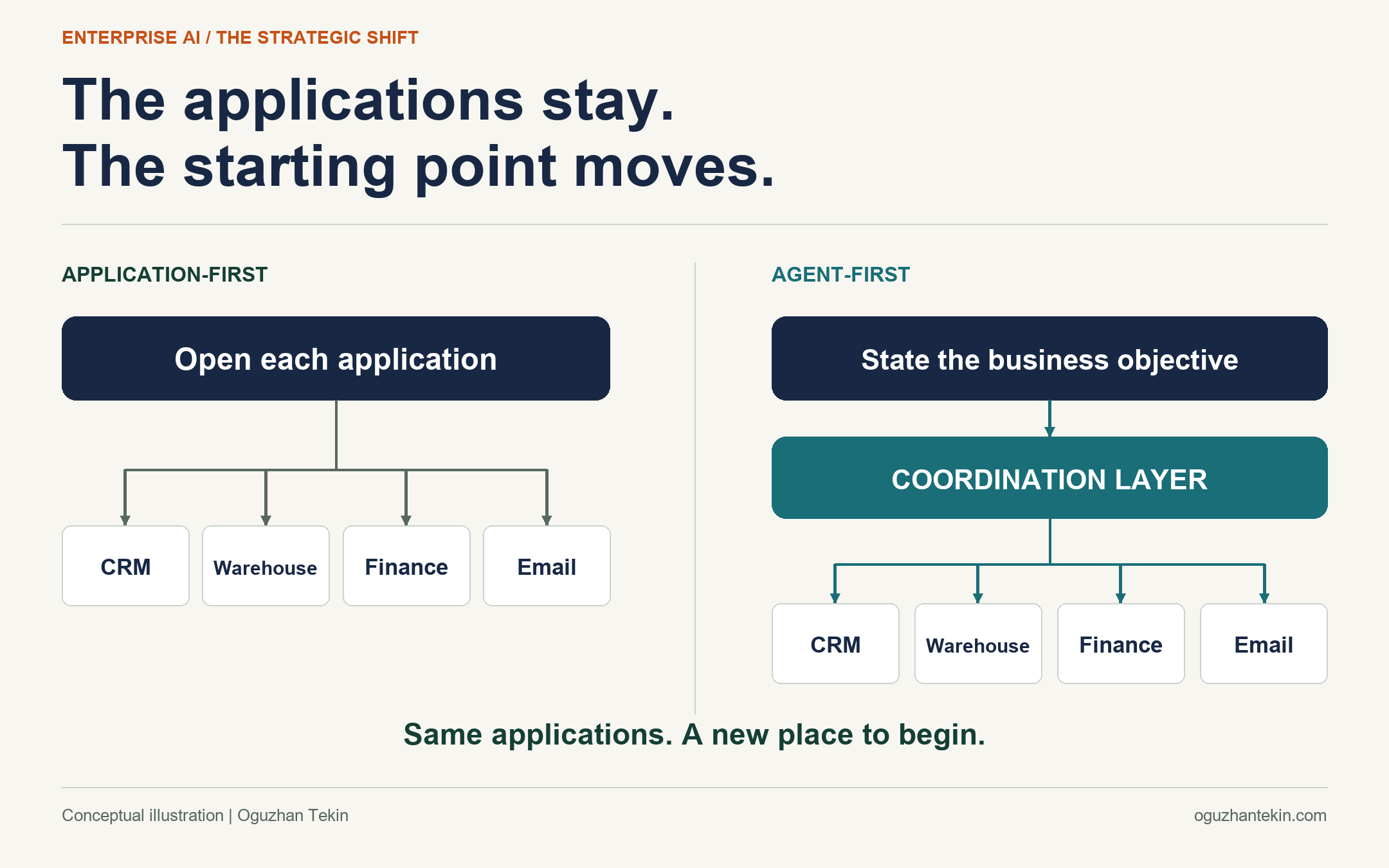
Much enterprise software competition has centered on becoming the system of record. AI introduces another opportunity: becoming the system through which people initiate, coordinate, and authorize work across those records.
If employees increasingly start with an agent rather than an application menu, the coordination layer could become where operational knowledge accumulates and vendor influence expands, even when the underlying applications remain unchanged.
This is more than a new interface. The platform can become the place where exceptions, approvals, handoffs, and business decisions are encoded into repeatable operating processes.
For example, it may hold the approved exception path for a delayed shipment, the approval threshold for a credit adjustment, and the recovery procedure for a failed warehouse handoff.
When teams capture and validate lessons from successful workflows, those lessons can improve subsequent work. Over time, the coordination platform may become more valuable not because of its technology alone, but because it contains a growing share of the organization's operating practices.
A provider can become more influential by operating or governing the work around applications it does not own.
Why rivals open doors
Oracle's October 27 announcement illustrates the shift. Its proposed AI Workspace is designed to let employees state a business objective in ChatGPT and draw on relevant Oracle applications, data, and cloud services to complete it.
The strategic significance is where work begins. Employees would begin with what they want to accomplish, rather than deciding which application to open.
Oracle benefits if customers extract more value from its existing systems. OpenAI benefits if ChatGPT becomes where those customers begin their next task.
Oracle's applications would continue holding records and executing approved changes. Its future-product disclaimer means this remains announced direction, not demonstrated general availability.
Salesforce's MuleSoft offers another example. Its A2A bridge presents Microsoft Copilot Studio agents as A2A-compliant so Agent Fabric can discover, govern, and orchestrate them without rebuilding the original agents.
Microsoft supplies the agent; MuleSoft can supply the coordination around it.
These connections solve an immediate customer problem. They also expand the territory over which suppliers can compete. Interoperability and platform strategy are not opposing explanations—they can reinforce each other.
Where each vendor seeks leverage
AWS approaches the opportunity through agent execution. Bedrock AgentCore supplies runtime, identity, memory, gateways, and monitoring across different models and frameworks. Model choice can remain open while the services required to operate agents become part of the customer's AWS relationship.
Microsoft's strategy centers on governing enterprise agents. Foundry Control Plane targets builders, while Agent 365 extends governance through existing identity, security, and management systems. Its opportunity is to make agent administration a continuation of infrastructure enterprises already depend on.
Google combines the employee's starting point with the platform behind it. Gemini Enterprise is positioned as a workplace front door, while its Agent Platform supplies execution and governance services. The strategic ambition spans both where work begins and how it operates.
These are different routes toward a similar position: becoming indispensable to the work connecting existing applications.
Their boundaries still matter. Microsoft's connected-platform integrations are read-only by design; registry synchronization alone does not enforce rules inside another supplier's runtime. Google's gateway documentation, reviewed November 3, still lists several deployment options, including cross-cloud support, as coming soon.
The value is real. So is the dependence.
The question is not whether to avoid coordination platforms, but whether their benefits are measurable and their controls remain under enterprise authority.
A shared coordination platform can reduce duplicated integrations, maintain context across handoffs, and make workflows easier to reuse. A shared control plane can simplify identity, logging, policy enforcement, and incident response.
Consolidation may therefore be rational when it delivers measurable reliability or compliance benefits. Maintaining independent components also requires money and expertise.
In CIO's March report on Cox Automotive, its chief product officer expected companies to anchor on a couple of vendors. The example concerns software development, not cross-application business operations, but the purchasing logic is relevant: concentration can coexist with enterprise-owned evaluation and human accountability.
Coordination can improve speed and consistency, but consequential business judgments—such as issuing a credit, promising a delivery date, or overriding a warehouse hold—must remain subject to clear human authority.
The dependence becomes more substantial when approval routing, credentials, policy histories, monitoring, and recovery procedures accumulate around one platform.
Replacing the connection is only part of replacing the workflow.
MuleSoft's bridge makes that concrete. Its launch post says "Copilot Studio sees the bridge, not the original caller," requiring caller authorization at the gateway. Its documentation also states that cancellation is unavailable and task lifecycle state does not survive a gateway restart.
The bridge is explicitly designed to be retired when native A2A fits the use case. That challenges a simple lock-in interpretation, but does not eliminate the work required to preserve permissions, approvals, and recovery behavior during replacement.
Measure successful work—and retained authority
For the delayed order, success is not merely an agent finishing its steps. It is an accurate resolution, approved where necessary, recorded correctly, and delivered without an unauthorized commitment or duplicate action.
Use cost per successful cross-system task: total in-scope cost over a defined period divided by tasks meeting predefined business acceptance criteria.
Include coordination charges, model and infrastructure usage, integration and support, human review, and failed-handoff rework. Unsuccessful attempts remain in the cost numerator.
Pricing will also shape the outcome. Microsoft's current per-user Agent 365 licensing shows that agents do not automatically end seat-based charges; how suppliers rebalance licenses, consumption, and coordination fees remains an open commercial question.
Keep an exit-cost estimate separate from measured operating costs. It should cover the workflow assets to rebuild and the work required to validate a replacement.
Retained authority means the enterprise can determine who may act, require approval for consequential actions, inspect what happened, restore interrupted work, and replace the platform without losing the workflow's operating controls.
The audit trail must therefore span the coordination layer and the applications executing changes. Buyers should test who authorized the action, which prompt and policy versions applied, who approved it, and how the workflow recovers if the warehouse handoff fails.
Enterprise applications may become less visible without becoming less important.
The strategic question is not only who owns the record of work, but who coordinates it.
Organizations should evaluate AI platforms not only by what they automate today, but by whether they preserve the enterprise's ability to authorize, audit, recover, and, when necessary, replace the systems that will coordinate tomorrow's business.