A support team reduces outsourcing after introducing AI. Specialist review increases. The platform team takes on new operating and assurance costs.
All three changes can be real. Only one appears in the support team's savings claim.
An enterprise AI saving requires an independently approved comparison, evidence from affected budgets, and explicit separation of cash from capacity.
One budget falls. Two others rise.
Consider this illustrative annual comparison:
| Budget | Without AI | With AI | Change |
|---|---|---|---|
| Support outsourcing | $300,000 | $200,000 | $100,000 less |
| Specialist contractors | $40,000 | $100,000 | $60,000 more |
| AI operation and assurance | $0 | $20,000 | $20,000 more |
| Total expenditure | $340,000 | $320,000 | $20,000 net cash saving |
Assume equivalent contact volume, complexity, and service quality. The specialist increase involves actual contractor payments, with no unrelated expenditure changes or reallocation of the released budget.
The support team's $100,000 reduction is real. But $80,000 of additional expenditure elsewhere leaves an enterprise cash saving of $20,000.
The boundary matters: a budget saving and an enterprise saving are not interchangeable.
The budget that reports the saving is not automatically the boundary across which its consequences should be measured.
If existing salaried specialists absorb the work instead, the result is $80,000 of cash released alongside specialist capacity consumed. An agreed $60,000 valuation of that capacity belongs in a separate disclosure — not another cash-outflow line.
Cash and capacity are both real. In this comparison, one changes expenditure; the other changes what the organization can do with resources it already pays for.
A capacity valuation can inform a decision; it cannot become a cash saving by relabeling.
Attribution also requires evidence. Costs could have risen or fallen for reasons unrelated to AI.
What the supporting evidence can and cannot show
These sources vary in evidentiary strength. They illustrate offsets and review work a claim should reconcile — not a universal savings rate or a case against AI savings.
CIO.com reporting by Grant Gross states that West Monroe reduced annual managed-service-provider costs by 40%. The same figure appears in AI vendor Moveworks' customer story. It is company-reported and vendor-promoted, not independent verification. Neither account discloses the offsets needed to turn that gross outsourcing reduction into a net enterprise saving.
In the same article's "Check the numbers" section, Jeet Pattanaik, founder and CTO of AI solutions provider Glokal AI, illustrates how €60,000 of apparent monthly support savings becomes €36,000 after reopened tickets and checking effort. It identifies work a claim should reconcile, but it is a vendor executive's illustration — not a measured customer case or established net cash saving.
Zhong and colleagues' arXiv preprint, v2, §III-B provides narrower behavioral evidence. In a sample of 300 open-source projects, human-led reviews of agent-generated code involved 11.8% more comments per conversation than reviews of human-authored code. The comparison involved 6,519 conversations on agent-authored pull requests versus 116,874 on human-authored ones. It does not establish causal effects, measured review hours, or enterprise budget increases.
Accenture's The CIO's guide to AI tokenomics identifies the same boundary problem: self-hosted models can reduce token spending while increasing infrastructure, talent, and operating costs.
UNICC's presentation at FinOps X Amsterdam makes cost attribution concrete. Carlos Correia describes linking AI usage to owners and business activity, while separately considering subscriptions, shared infrastructure, and service-delivery labor. This is a practitioner-reported approach, with broader oversight still being developed — not an audited savings case.
But attribution is not validation: knowing who pays for a request does not establish who absorbed its consequences. Cost attribution is necessary for governance, but insufficient for validating an enterprise saving.
Productivity evidence establishes that work changed. It does not, by itself, establish which budgets absorbed the change, whether quality held across the whole workflow, or whether the organization is better off after new costs.
Noy and Zhang found 40% faster writing-task completion. Brynjolfsson, Li, and Raymond found 15% more support issues resolved per hour. Humlum and Vestergaard found task changes without detectable earnings or recorded-hours effects through December 2024.
Faster work creates an opportunity, not an accounting result.
Three checks before an enterprise AI saving is validated
Benefit ownership already exists in benefits-realization practice. FinOps guidance on unit economics and Tokenomics guidance on realized AI value also address attribution and value measurement.
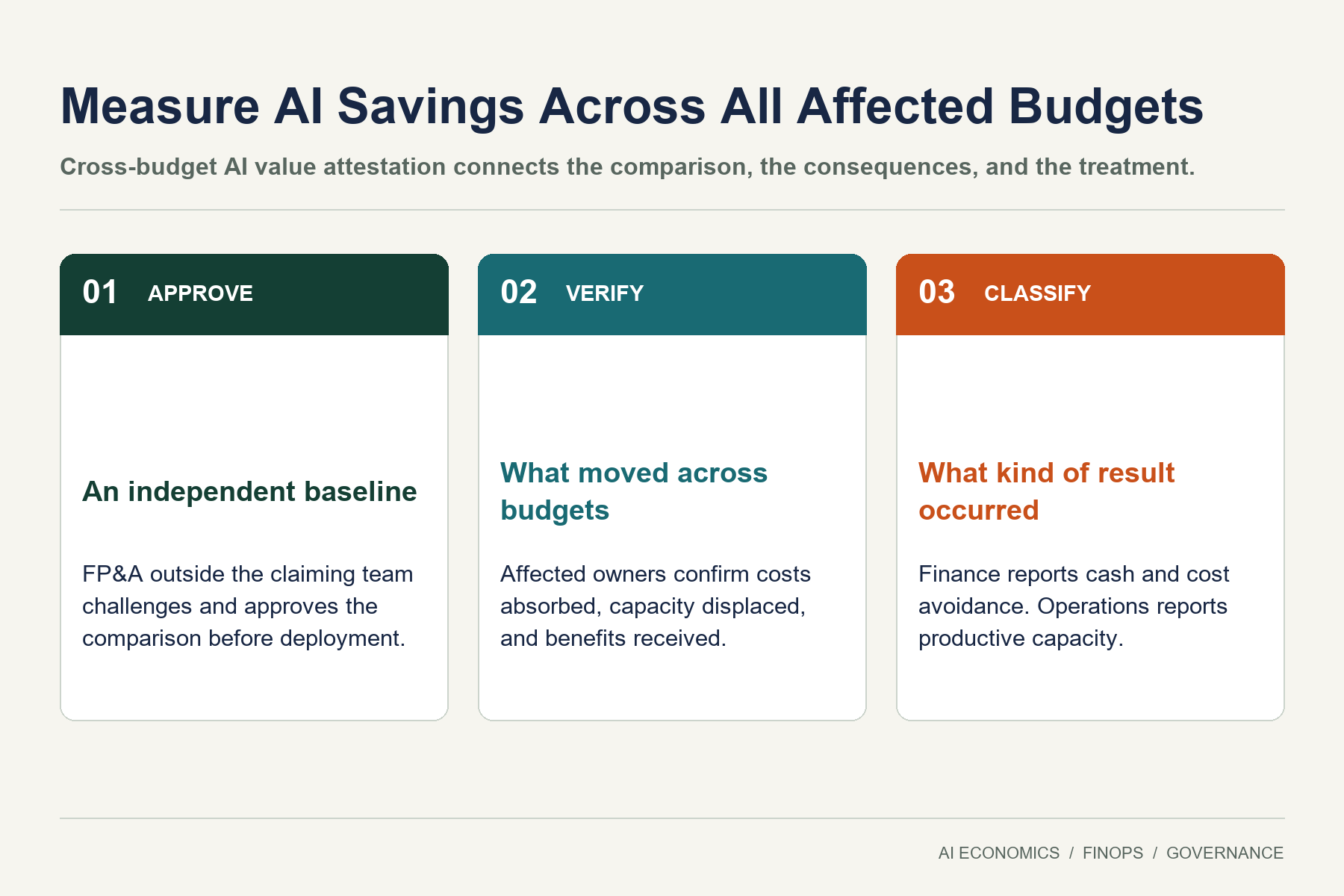
My proposed cross-budget AI value attestation adds evidence-backed confirmation by affected budget owners of attributable costs, displaced capacity, and benefits received before an enterprise saving is validated.
-
Approve the counterfactual independently. FP&A outside the claiming team challenges and approves the baseline, demand assumptions, comparison period, and materiality threshold before deployment. Business and quality owners define acceptable outcomes and service thresholds. Unresolved baseline disputes go to the accountable executive before deployment. Existing deployments use a labelled reconstructed baseline with greater uncertainty.
-
Verify what moved across budgets. Affected owners confirm costs absorbed and benefits received using invoices, ticket counts, reopen rates, review hours, and quality records. Estimates remain labelled. Claimants can favor their baseline; affected teams can overstate absorbed work to protect their budgets. Operational records — not either side's assertion — should anchor the reconciliation.
-
Determine the financial treatment. Finance distinguishes cash removed from expenditure avoided against a documented pre-deployment budget or hiring plan. Operations reports capacity released or consumed, including whether released capacity was productively used. Net cash changes against cash changes, and comparable capacity changes against capacity changes. Any conversion of capacity into dollars remains labelled as a valuation — not expenditure removed.
Baseline disputes concern the comparison approved before deployment. Amount disputes concern subsequent measurement or classification.
FP&A reconciles amount disputes and records disagreements. Because FP&A also approves the baseline, materially contested financial decisions should escalate to the accountable executive before Finance finalizes treatment.
Apply this control when changes exceed a pre-agreed tolerance for expenditure, staffing, workload, risk, or service commitments. For example, a customer-facing support workflow might warrant a lower tolerance than an internal drafting tool because errors and escalations have more direct external consequences.
Label claims forecast, observed, or validated. Validated means independently reviewed against the approved baseline over a stated period — not permanently guaranteed. Reassess when demand, quality, pricing, workflows, staffing, or evidence of shifted work materially changes.
Cross-budget AI value attestation is a proposed control, not an evidenced one. Pilot it on one material, high-risk use case first.
Cross-budget attestation does not require every AI use case to produce a cash saving. It requires organizations to state what kind of result occurred, where it occurred, and who verified it. The purpose is to make savings harder to overstate — and benefits received elsewhere harder to overlook.
Who approved the baseline, when — and who signed off on the work that moved?
References
- Gross, G. Where AI agents are showing real IT savings. CIO, October 1, 2026.
- Moveworks. How West Monroe achieved over $1.4 million in savings. Undated vendor-published customer story; accessed October 31, 2026.
- Zhong, Suzhen; Noei, Shayan; Zou, Ying; and Adams, Bram. Human-AI Synergy in Agentic Code Review. arXiv:2603.15911, first submitted March 16, 2026; v2, October 26, 2026. Metric: §III-B, equations 1–2 and Figure 7. The abstract describes "rounds"; the results define average comments per conversation. Preprint.
- Accenture. The CIO's guide to AI tokenomics: How to see, control and account for AI token spend at scale, September 10, 2026. Report, pp. 26 and 34.
- DS TV / Tokenomicon. Tokenomicon + FinOps X Amsterdam 2026 Keynote: AI Tokenomics, Total Cost of AI, and FOCUS 1.5. Carlos Correia, UNICC, 1:05:11–1:08:04; Stephen Arthur, Tokenomics Foundation, 50:43–51:13. Timestamps refer to the published video.
- Noy, S., and Zhang, W. Experimental evidence on the productivity effects of generative artificial intelligence. Science, 2023.
- Brynjolfsson, E., Li, D., and Raymond, L. Generative AI at Work. Quarterly Journal of Economics, 2025.
- Humlum, A., and Vestergaard, E. NBER Working Paper 33777. May 2025; revised March 2026.
- HM Treasury. Government Efficiency Framework: Key definitions and criteria, §§1.2–1.4. Supports net-cost assessment, cash-releasing and noncash distinctions, and consideration of adverse cost transfers. This article's labels are not its exact taxonomy.
- FinOps Foundation. Unit Economics.
- Tokenomics Foundation. Classifying and Measuring Realized Value from AI, RC2, September 16, 2026. Release-candidate guidance; not peer-reviewed. Its methodology and Stephen Arthur's presentation are related materials from the same foundation, not independent corroboration of the same-unit principle.