Knowing what AI costs does not answer which workload should run next.
My earlier articles examined the agent harness — the execution, tools, and verification surrounding a model, spending policies as access controls, and how apparent savings move costs between budgets.
This article addresses the next operating decision: what happens when legitimate AI workloads compete for a budget that cannot expand?
Carlos Correia's UNICC presentation makes that constraint concrete. The United Nations International Computing Centre connects where AI runs, how consumption is attributed, and what value it delivers. Predictable expenditure matters alongside capability, quality, and unit price.
The method below is my proposed application of existing FinOps principles, informed by UNICC's presentation and Spotify's published example. It is not a reported UNICC implementation. All numerical examples and review windows are synthetic.
The contribution is a decision process for authorizing expenditure before it occurs. It connects permitted routes, business priorities, available allowance, and outcome evidence. It does not replace cost-per-outcome analysis; it turns that analysis into an operating decision.
The six steps — Classify, Own, Meter, Cost, Optimize, and Prove — produce the evidence and controls needed for admission. The ledger is where Own, Meter, and Cost become a decision about whether work may proceed.
Classify determines which routes are eligible. Optimize supplies evaluated alternatives. Prove determines whether continued or expanded spending is justified.
Establish the evidence before admitting work
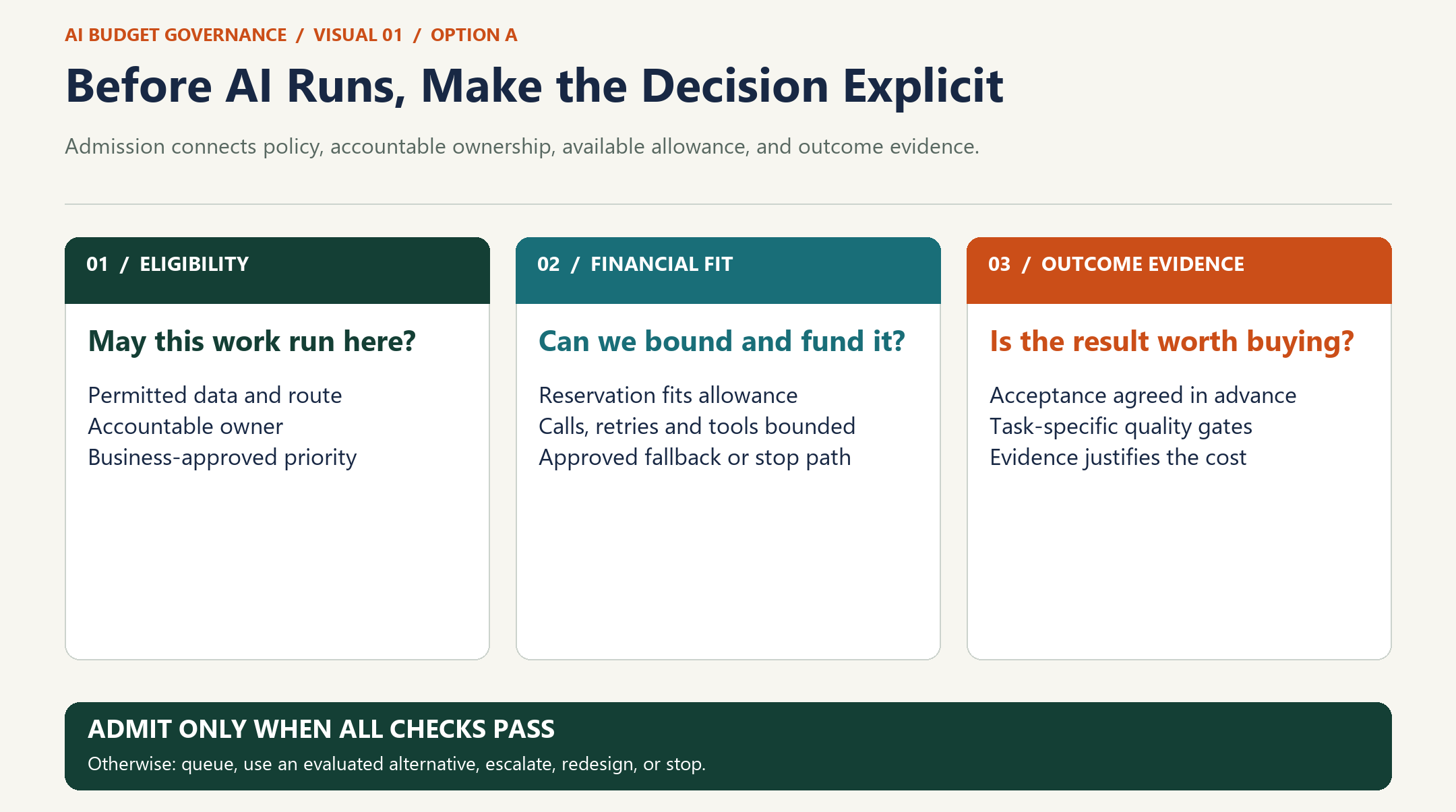
Before a request can compete for allowance, the organization needs four kinds of evidence: where it may run, who owns and prioritizes it, how its consumption is identified, and whether its delivery cost is worthwhile.
Classify — determine permitted routes.
UNICC describes private infrastructure, trusted partner high-performance computing (HPC), and approved external services. Correia's presentation explicitly includes hyperscalers and frontier-model providers among the external routes.
Record data classification, processing locations, provider access and model-use terms, quality requirements, and deadlines. Apply them to downstream tools and delegated models too.
A cheaper destination is not an alternative if the workload cannot use it.
Own — assign accountability and ordering.
Each workload needs an owner, budget period, priority, and exception authority. Priority is approved by the accountable business owner and recorded in the workload policy; applications cannot assign or change it at request time.
Distinguish essential, time-sensitive, and deferrable work. Priority determines ordering and available responses, not exemption from policy.
For competing requests, use a pre-agreed sequence: business priority first, evidence of expected outcome value second, and cost per accepted outcome as a tie-break among comparable alternatives.
Evidence may range from a lightweight estimate for routine work to a documented evaluation for new, high-consequence, or high-cost workloads.
Comparable means the alternatives serve the same workload and acceptance rules, operate within the same service period, and use a documented cost boundary. Merely producing forecasts does not make two workloads comparable.
Set maximum deferral periods. Reaching one triggers an accountable decision to fund, reschedule, redesign, or cancel — not an automatic policy bypass.
Meter — preserve identity across the chain.
Managed platforms do not eliminate the need for end-to-end observability.
AWS Bedrock documents invocation, latency, token, error, throttle, and cache-related metrics. Microsoft's Foundry classic monitoring documentation describes Azure OpenAI monitoring. Application records must still connect those signals to owners, outcomes, and downstream work.
Preserve logical request identifiers and their individual attempts. Reconcile gateway observations, provider charges, intermediary fees, and customer billing rather than adding overlapping records as separate expenses.
Cost — maintain two distinct views.
The spend-control view determines whether new work fits its approved financial allowance. The fully loaded evaluation view determines whether delivering that work is worthwhile.
Fully loaded cost includes attributable model usage, subscriptions, infrastructure, platform operations, governance, review, and rework.
Cost per accepted outcome = fully loaded in-scope delivery cost ÷ accepted outcomes
"In-scope" means attributable to the evaluated workload, per a documented allocation policy. Costs and outcomes must belong to the same cohort and service period.
Acceptance requirements must be agreed before evaluation by the service owner, output consumers, and relevant reviewers. Acceptance cannot rest on the agent's own claim that it finished. Count accepted work items once; include failed attempts and their costs.
Pending items retain their incurred costs but cannot enter the accepted denominator. Report unit cost as provisional while evaluations remain incomplete. With zero accepted outcomes, the ratio is undefined.
These views are not interchangeable. Lower allocated staff effort does not necessarily create cash available for more API calls.
Make the admission decision explicit
Alerts inform; controls constrain. A notification can support investigation without preventing further model consumption.
The FinOps Foundation's Budgeting guidance connects funding, accountability, holdbacks, thresholds, and defined responses. The following ledger translates those principles into a request-level control.
| Spend-control item | USD, synthetic |
|---|---|
| Approved allowance | 12,000 |
| Incurred charges, including usage consumed but not yet invoiced | 9,000 |
| Reservations for additional charges from work in progress | 800 |
| Protected contingency | 1,200 |
| Available for ordinary new work | 1,000 |
Available allowance = approved allowance − incurred charges − reservations − protected contingency.
Here: 12,000 − 9,000 − 800 − 1,200 = 1,000.
Reservations cover charges not already recorded as incurred. Contingency provides headroom for delayed reporting, estimation error, and authorized exceptions. These amounts must not overlap.
Admission rule: admit work only when its policy classification permits the route; an accountable owner and priority exist; a defensible reservation fits available allowance; execution and fallback or stop paths are approved; and evaluation evidence supports the expected outcome at the reserved cost.
Cost per accepted outcome informs that last test. It does not override policy, priority, service obligations, or available allowance.
A stop path may reject new work, cancel queued descendants, notify the owner and requester, and release unused reservations once outstanding charge exposure is reconciled. Cancellation does not erase charges already incurred.
The admission ledger must be authoritative and auditable. It may operate in a gateway, FinOps platform, workflow engine, or internal service, but concurrent admissions must not depend on independently cached balances. Name its technical operator and financial reconciliation owner.
Three requests, one constrained balance
Suppose three forecasting jobs compete for the USD 1,000. The jobs, amounts, and review windows below are synthetic, not recommended universal thresholds.
| Job | Approved priority and evidence | Reservation, USD | Decision | Available allowance after decision, USD |
|---|---|---|---|---|
| A: planning forecast update | Time-sensitive; stronger evidence of supporting an imminent decision | 600 | Admit | 400 |
| B: additional scenario analysis | Time-sensitive; lower expected incremental benefit | 500 | Queue | 400 |
| C: historical reprocessing | Deferrable; useful but not deadline-critical | 500 | Queue | 400 |
A and B share a priority class, but the approved evidence-based ordering favors A. After admission, total reservations rise from USD 800 to USD 1,400. Queuing B and C makes no reservation, so neither changes the USD 400 remaining balance.
If A completes with reconciled charges of USD 450, that amount moves into incurred expenditure and its USD 600 reservation closes. The unused USD 150 is released, making USD 550 available.
B can now be reconsidered. It receives a new USD 500 reservation only after the normal admission checks pass again, leaving USD 50 available. Queue placement does not guarantee admission.
B receives a review by its accountable owner within two hours or before its deadline, whichever comes first. That review may admit B if allowance becomes available, seek an authorized contingency allocation, reschedule it, redesign it, or cancel it. C receives a review within one business day.
Partial funding is appropriate only when reduced scope remains independently useful, has its own acceptance criteria, and can be evaluated as a distinct work item. Otherwise, admit, queue, redesign, or cancel the request as a whole.
Essential work does not skip the ledger. When ordinary allowance is exhausted, it may trigger the approved continuity and contingency process rather than an automatic interruption.
A contingency draw requires the budget owner's financial authorization and the service owner's confirmation of operational need. Record the reason, amount, affected workload, and replenishment plan where applicable.
The approved draw reallocates protected contingency into allowance available for the specified request. The normal admission rule then applies, including policy checks and a reservation that fits that allowance. The draw neither bypasses admission nor increases the overall budget.
Make the reservation enforceable, not merely visible
Use an atomic reservation-and-release mechanism: reserve before dispatch, reconcile against actual usage, and release only unused reservation. Concurrent admissions must update the same authoritative balance. Repeated submissions must not create duplicate reservations.
A defensible reservation reflects enforced bounds on input and output tokens, attempts, descendant calls, fan-out, and chargeable tools, priced using applicable rates. Work exceeding those bounds requires another affordability check.
Estimated reservations improve control but do not guarantee a hard cap where provider billing is delayed or usage can exceed the estimate.
A defensible cap requires bounded charges across every spending path, synchronized admissions, verified enforcement, and suitable provider-side spending controls or non-overdraft prepaid arrangements where available. Rate quotas alone are not monetary caps.
Where those conditions cannot be established, describe the mechanism as a spending guardrail and disclose residual exposure.
Optimize — prepare alternatives before scarcity arrives.
In Spotify's example, Dimitri Mazmanov routes routine file reading and predictable generation to a lower-cost worker model.
Although the headline refers to a 90% reduction, the article reports approximately 90% mean savings in Claude's bulk-read token consumption, within an evaluation spanning four scenarios in one Java monorepo. Worker usage, platform charges, latency, retries, validation, and rework still determine total economics.
The article also reports a worker missing a thread-safety bug.
An evaluated alternative is an admission-control asset: eligible work can use a route whose quality, data terms, and cost behavior have already been assessed.
Each alternative needs approved data-handling terms, task-specific quality gates, expected consumption, and a fallback policy. Scarcity should activate an approved option, not an improvised downgrade.
The FinOps for AI Overview supports allocating first, evaluating workload economics, and considering commitments once usage is stable.
Prove — test regressions and allocation sensitivity
Consider a retrospective paired evaluation of 1,000 forecasting opportunities, with complete labels and unchanged accuracy, timeliness, and review requirements.
| Measure | Treatment — all figures synthetic | Baseline | Alternative |
|---|---|---|---|
| Model/API charges | Variable, case-attributed; USD | 4,000 | 2,500 |
| Review and rework | Case-attributed effort valuation; USD, not necessarily variable payroll | 4,000 | 3,500 |
| Platform, data, infrastructure, and governance | Fixed allocation for this cohort; USD | 4,000 | 4,500 |
| Fully loaded cost | USD | 12,000 | 10,500 |
| Accepted forecasts | Count | 900 | 950 |
| Pending | Count | 0 | 0 |
| Cost per accepted forecast | USD | 13.33 | 11.05 |
The modeled unit-cost reduction is 17.1%, but two checks matter before adoption.
First, inspect what changed. One consistent paired result is 870 accepted by both approaches, 80 improved, 30 regressed, and 20 accepted by neither. The net gain of 50 does not erase the regressions.
Define blocking conditions before evaluation. For a designated high-consequence subgroup, prohibit specified failures or set a maximum regression rate consistent with mandatory requirements. Specify the evidence and uncertainty needed to assess the gate; a small sample does not establish that it passed.
If the gate fails, the aggregate improvement does not authorize rollout.
Second, test the allocation. Holding the baseline, acceptance counts, and other alternative costs constant, the alternative breaks even at approximately USD 12,667 total cost. Its fixed allocation could rise from USD 4,500 to approximately USD 6,667 before the modeled unit-cost advantage disappears.
That is a sensitivity threshold, not permission to increase expenditure.
With real case-level data, a paired bootstrap is one option for uncertainty: resample matched opportunities together and cluster dependent observations where appropriate.
Hold fixed cohort allocations constant only when they are genuinely fixed; otherwise model how they vary with volume, duration, or usage. Resample case-attributed costs consistently with that policy. The appropriate method depends on the matching design, cost structure, and dependence between observations.
Finally, accepted forecasts demonstrate service performance, not mission value. A prospective pilot must establish whether they improve actual decisions. The USD 1,500 fully loaded difference is not automatically spendable cash.
Put the method into practice
Start with one workload and three artifacts:
- Workload policy: permitted routes, acceptance rules, priority ordering, maximum deferral, and exception authority.
- Admission ledger: authoritative balance, reservations, actual charges, contingency approvals, and unresolved differences.
- Outcome review: accepted and pending counts, regressions, allocation sensitivity, and operational benefit.
Test concurrent admissions, duplicate submissions, exhausted allowance, delayed usage records, failed calls, and unavailable approved routes before relying on enforcement.
Watch for these failure modes:
- Relying on alerts where enforcement is needed.
- Allowing priority labels to bypass policy.
- Letting queued work age without an accountable decision.
- Delegating without task-specific quality gates.
- Counting overlapping meters as separate expenses.
- Treating allocated savings as spendable cash.
Admission control does not resolve underfunding, poor workload design, or missing outcome evidence. It makes those constraints visible and forces an explicit decision before further expenditure.
The objective is controlled expansion. Before the next request runs, the organization should be able to explain why it takes precedence, where it may execute, how its charges are bounded, and who owns the result.
References
- Carlos Correia, "United Nations Sovereign Tokenomics: Fixed Budgets, Variable AI Demand," presented at Tokenomicon + FinOps X Amsterdam, 23 September 2026; video published 28 September 2026.
- FinOps Foundation, "Budgeting." Accessed 1 November 2026.
- FinOps Foundation, "FinOps for AI Overview." Accessed 1 November 2026.
- Dimitri Mazmanov, "Portal by Spotify cut my Claude Code token usage by 90%," Spotify Portal, 3 September 2026, updated 8 September 2026.
- AWS, "Monitor bedrock-runtime inference using CloudWatch metrics." Accessed 1 November 2026.
- Microsoft, "Monitor Azure OpenAI in Microsoft Foundry Models (classic)." Applies to Foundry classic; accessed 1 November 2026.